
Hello readers,
Goodnight!
In this post I will quickly demonstrate how to retrieve the largest value among multiple columns in a SQL Server table. I've seen several solutions for this need, but are you using the most performant among them?
Generating a mass of tests
To make it easier to visualize the results, let's create some test data:
IF ( OBJECT_ID('tempdb..##Teste') IS NOT NULL ) DROP TABLE ##Teste
CREATE TABLE ##Teste (
    ID INT IDENTITY(1, 1) PRIMARY KEY,
    Nome NVARCHAR(40),
    Data1 DATETIME,
    Data2 DATETIME,
    Data3 DATETIME
)

DECLARE
    @Dt_Inicial DATETIME = '1900-01-01',
    @Dt_Final DATETIME = '2099-04-02',
    @Contador INT = 1

WHILE(@Dt_Inicial <= @Dt_Final)
BEGIN

    INSERT INTO ##Teste ( Nome, Data1, Data2, Data3 )
    SELECT
        'Teste ' + CAST(@Contador AS VARCHAR(20)),
        @Dt_Inicial,
        DATEADD(DAY, ABS(CHECKSUM(NEWID()) % 5000) - ABS(CHECKSUM(NEWID()) % 5000), GETDATE()),
        DATEADD(DAY, ABS(CHECKSUM(NEWID()) % 5000) - ABS(CHECKSUM(NEWID()) % 5000), GETDATE())

    SET @Dt_Inicial = DATEADD(DAY, 1, @Dt_Inicial)
    SET @Contador = @Contador + 1

END

SELECT * FROM ##Teste
Original Data:
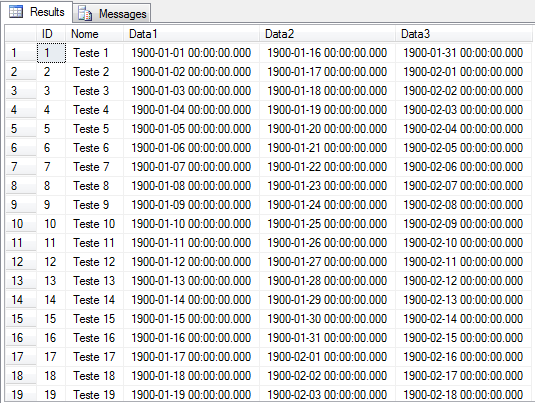
Expected Result:

Solution 1 – Using VALUES
SELECT
    ID,
    (
        SELECT MAX(UltimoAcesso)
        FROM (VALUES (Data1),(Data2),(Data3)) AS UltimoAcesso(UltimoAcesso)
    ) AS UltimoAcesso
FROM
    ##Teste
Solution 2 – Using UNPIVOT
SELECT
    ID,
    MAX(UltimoAcesso) AS UltimoAcesso
FROM
    ##Teste
    UNPIVOT ( UltimoAcesso FOR DateVal IN ( Data1, Data2, Data3 ) ) AS u
GROUP BY
    ID,
    Nome
Solution 3 – Using UNION
SELECT
    ID,
    MAX(UltimoAcesso) AS UltimoAcesso
FROM
(
    SELECT ID, Data1 AS UltimoAcesso
    FROM ##Teste

    UNION

    SELECT ID, Data2 AS UltimoAcesso
    FROM ##Teste

    UNION

    SELECT ID, Data3 AS UltimoAcesso
    FROM ##Teste
) ud
GROUP BY
    ID
Performance Test
After understanding the 3 solutions proposed above, we will test performance to identify which one is executed with the lowest possible time and cost. This way, we will be able to say what the best solution adopted for this situation should be:
Solution 1

Solution 2:

Solution 3:

End result:

As we can see, solution 1, in addition to being very small, is the most performant.
Thanks for visiting!
sql server largest value from multiple columns in a table view query Find MAX value from multiple columns in a SQL Server table
sql server largest value from multiple columns in a table view query Find MAX value from multiple columns in a SQL Server table

Comments (0)
Loading comments...