Hey guys,
Are you all right?
I'm a little absent here on the blog, but I'll soon be back posting much more frequently, as soon as I complete some projects and consultancies I'm doing. In the meantime, I couldn't help but share with you some tips, materials and links that can help you prepare for SQL Server 2016 MCSA and MCSE certification exams and tests, just as I have been preparing for the last few months.
If you are preparing for your first certification test and want to start with the MTA, I created the post Microsoft Certifications – Study material in Portuguese to obtain your first certification (MTA) to help and answer questions for those who are just starting out in the world of certification and want to know more about this certification.
First of all, let's learn about Microsoft's current certifications for the Data Platform and begin to familiarize ourselves with the acronyms:
- MTA (Microsoft Technology Associate): It is Microsoft's first certification test and the easiest, recommended for people who are starting their careers and are still getting familiar with technology. She no is a prerequisite for taking the MCSA and MCSE tests and taking it is optional.
As an incentive to take the MTA test, Microsoft gives a small discount on taking this exam (you pay 77 dollars instead of 100 dollars for the other MCSA and MCSE tests)
- MCSA (Microsoft Certified Solutions Associate): Medium/high level test, aimed at people who already have experience with the technologies involved.
MCSA certification is a prerequisite for obtaining MCSE certification. - MCSE (Microsoft Certified Solutions Expert): The last level of Microsoft certification tests, the MCSE tests tend to be the most difficult among the Microsoft tests, and must be taken by highly trained professionals with great experience and experience in the technologies in question.
Why make sure?
The BornToLearn blog, world-renowned by the Microsoft technical community, made a post available where they mention 6 advantages that professionals can obtain by becoming certified (You can check the post on this link here), which is summarized in the image below:
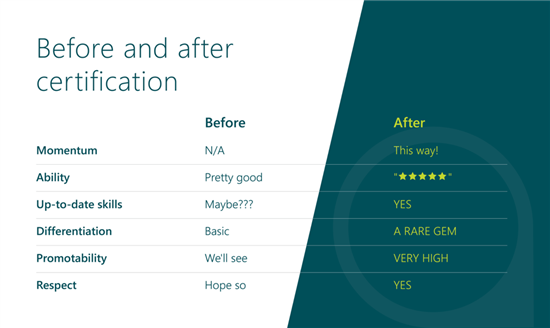
- Before a certification, it's a challenge to start advancing your technology career. After certification, you have strong momentum towards the next big hurdle. In fact, 33% of certified professionals reported having secured a job after certification. Plus, getting certified is addictive.
- Keeping up when you're new to the job is a challenge. The good news is that certification gives you a proven foundation of specialized, real-world knowledge to build on, so you'll be ready to move up in the workplace 39% faster than your peers. If you're still not convinced, 38% of IT professionals said certification helped them perform complicated tasks with more confidence. It's science.
- It's a struggle to differentiate yourself and show that you're the best person for the job when you're starting out in the tech industry. Isn't it good to know that 91% of hiring managers consider certification as part of their hiring criteria? We think so. Going into interviews knowing that you are certified will make you feel great.
- Stay up to date and never run the risk of obsolete skills. When you maintain your certifications, you can be confident that your skills are up to date. So you can be confident in the experience you have while gaining new tricks, such as new technologies and features, when industry standards change.
- Getting impatient for the next promotion? The solution is quite simple. If you are certified, you receive more pay raises and more chances to move up in your career. Plus, you start right out of the gate earning 15% more on average than your non-certified peers.
- Perhaps the most important. When you are certified, you are recognized in the industry as an expert. Employers like their certified hires so much that they typically keep them around 15% longer than other employees. When will you be certified??
Video of MVP Rafael Bernares about the importance of certification
What are the Microsoft certification tests like?
If you have never taken it, I would like to prepare you well, as Microsoft certification tests tend to be very difficult, since:
- Some tests have discursive questions, where you need to write SQL queries following several rules, according to the statement.
- In some questions, the answer is a composition of 4 options, out of about 10, where you must mark the correct alternatives and align them in the correct order of execution. The chance of you getting a question like this right “on the fly” is very small.
- In some questions, all the answers are correct, but you must choose the option that has the best performance, that is, the cheapest, financially, for example.
- In some stages of the test, you don't have the chance to go back to the question and think better about the correct answer: You clicked on next, there's no going back.
- Generally the time is short: 3 minutes per question and some have a statement with more than 10 lines of text.
Microsoft certification tests cost $100 (If you are a student, you have a 50% discount. See how to get your discount HERE) and you must get a grade equal to or greater than 700, worth 1000, to pass the exam (700 is not 70% of the test).
These exams usually have a translated version into Portuguese (except the Beta or recently launched exams, where there is only an English language option), but technical terms are usually translated as well (View = Vision, Trigger = Trigger, etc.), which can end up confusing you during the test. In my opinion, a professional who aspires to be certified and pursue a career as a DBA can no longer afford the luxury of not knowing how to at least read texts and articles in English.
NOTICE: If you have been working in the IT area for some time, you may have heard of some tests that are sold/distributed on the internet with the same questions that are applied in the certification exam. Many IT “professionals” end up acquiring this type of test and, instead of studying and learning to take the test, they end up memorizing the questions and answers (often, they don't even know what they are memorizing) and manage to pass the exams. Avoid this type of “study”, as there is no point in having several certificates on your CV and when you go to join a company, which hired you because of these certifications, you end up “embarrassed” for not having all the knowledge you appeared to have. In the technical community, this type of “study” is highly repudiated and discouraged.
What about beta tests? How do they work?
When Microsoft is preparing to launch certification tests, it makes some codes (vouchers) available to IT professionals (generally 300 vouchers per test, worldwide), so that they can take these test tests and give their feedback on the questions.
Despite being BETA tests, their results are computed and are valid for the certification process, in the same way as a paid test. As explained in this link, if you pass the beta test, you will not need to repeat the test when the final version comes out. If you do not pass the beta test, you will not be able to repeat the beta test again and must wait for the final version to be released before retaking the exam.
Since the tests are still in the testing phase (they are BETA), you should be aware of the possibility of errors in the questions. Furthermore, the tests are generally only available in English and instead of a few randomly chosen questions, the test contains many more questions (generally 59-62 instead of the 35-40 of a “normal” test), so the beta test is usually longer than the final test.
Another difference between the final version of the tests and the beta version is that in the final version, the result is generated as soon as you finish the test, while in Beta tests, the result is only released several weeks later (when the final version of the test is made available) – Generally around 4 months.
How do I become an MCSA on Data Platform?
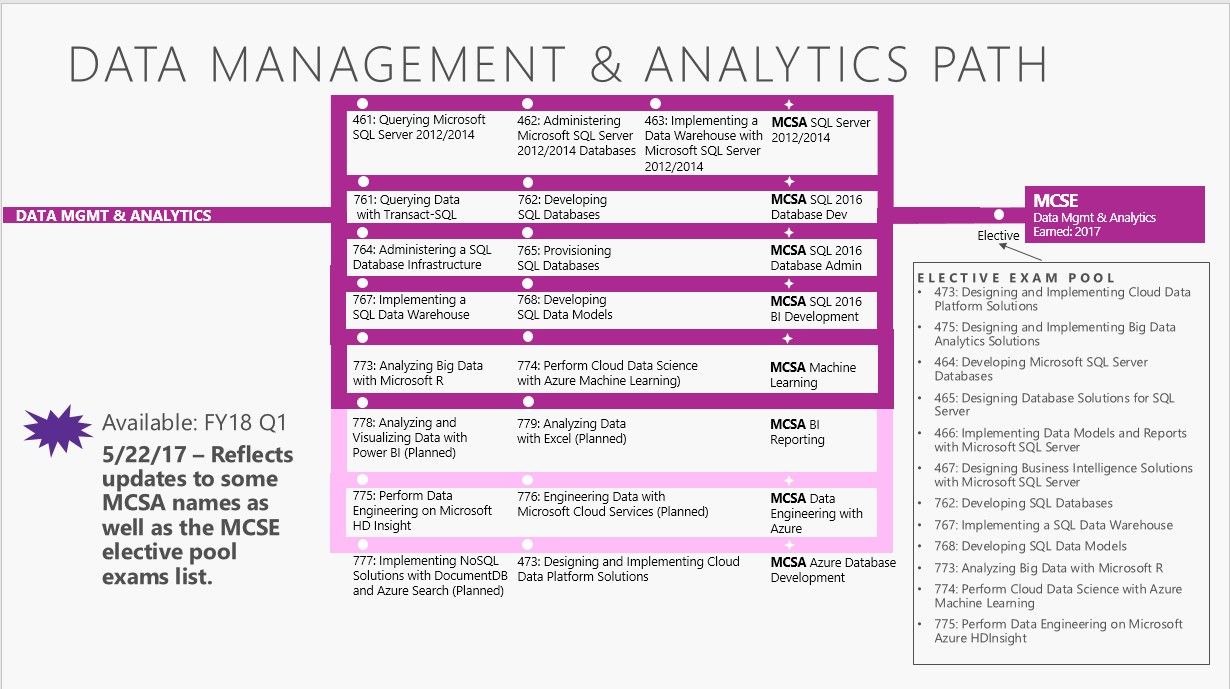
As you may know, the MCSA Certification Path for SQL Server 2016 changed a lot in relation to SQL Server 2012/2014, where you needed to pass 3 tests, 1 for Database Dev, another for Bank Administration (DBA) and another for BI, which didn't really make much sense, since they are different careers within Microsoft's Data Platform area.
Now in the SQL Server 2016 MCSA Certification Path, you need to pass just 2 tests from the same area of activity, be it DEV, DBA or BI. In other words, if you only pass 1 DEV test and another DBA test, you no will have the title of MCSA.
Understand better by viewing the image below:
How do I become an MCSE Data Management and Analytics?
If you want to become a Microsoft Certified Solutions Expert on the Microsoft Data Platform, you will need to meet the 2 requirements below:
- Become an MCSA SQL Server 2012/2014 OR MCSA SQL Server 2016 (BI, DEV or DBA)
- Pass at least one of the following tests:
Exam 70-464 – Developing Microsoft SQL Server Databases (DEV)
Exam 70-465 – Designing Database Solutions for Microsoft SQL Server (DBA)
Exam 70-466 – Implementing Data Models and Reports with Microsoft SQL Server (BI)
Exam 70-467 – Designing Business Intelligence Solutions with Microsoft SQL Server (BI)
Exam 70-473 – Designing and Implementing Cloud Data Platform Solutions (DBA)
Exam 70-475 – Designing and Implementing Big Data Analytics Solutions (BI)New elective tests for MCSE. To win the title, there are some criteria. It is not enough to take the test and obtain the title, as is the case in the tests above:
Exam 70-762 – Developing SQL Databases (DEV)
Exam 70-767: Implementing a Data Warehouse using SQL (BI)
Exam 70-768: Developing SQL Data Models (BI)
Exam 70-773: Analyzing Big Data with Microsoft R (BI)
Exam 70-774: Perform Cloud Data Science with Azure Machine Learning (BI)
Exam 70-775: Perform Data Engineering on Microsoft Azure HDInsight (BI)
UPDATE: In June 2017, Microsoft started to recognize as MCSE professionals who have 2 or more MCSAs in the same area, that is, if you have 2 Data Platform MCSAs, you are already an MCSE as soon as you pass the 2nd exam of your 2nd MCSA.
Note: In the MCSE test, the area of activity of your MCSA is irrelevant to obtaining the title. Once you are MCSA, you can take any of the MCSE exams to be recognized as a Microsoft Certified Solutions Expert on the Microsoft Data Platform. In other words, if you are a BI MCSA (Passed 70-767 and 70-768), for example, and pass 70-464, which is theoretically aimed at Database Developers, you will become an MCSE Data Management and Analytics.
Microsoft Technology Associate (MTA)
Exam 98-364: Database Fundamentals (Exam Link)
Study Links
- Understand how data is stored in tables
- Understand relational database concepts
- Understand data manipulation language
- Understand data definition language (DDL)
Create Database Objects
- Choose data types
- Understand tables and how to create them
- Create views
- Create stored procedures and functions
Manipulate Data
- Select data
- Insert date
- Update data
- Delete date
Understand Data Storage
- Understand normalization
- Understand primary, foreign, and composite keys
- Understand indexes
Administer a Database
- Understand database security concepts
- Understand database backups and restore
MCSA SQL Server 2012/2014
If you want to become an MCSA certified professional for SQL Server 2012/2014 (Yes, it is a certification for both versions), you will need to pass the 3 tests below.
Exam 70-461: Querying Microsoft SQL Server 2012/2014 (Exam Link)
Study Links
Create database objects
- Create and alter tables using T-SQL syntax (simple statements)
- Create and alter views (simple statements)
- Design views
- Create and modify constraints (simple statements)
- Create and alter DML triggers
Work with data
- Query data by using SELECT statements
- SELECT Clause (Transact-SQL)
- SQL Server Ranking Functions Row_Number and Rank
- SQL Server Synonyms Tips
- FROM (Joins, Apply, OPENXML)
- Compare SQL Server Datasets with INTERSECT and EXCEPT
- Information Schema Views (Transact-SQL)
- INFORMATION_SCHEMA.TABLES
- COALESCE vs. ISNULL
- Writing efficient queries
- T-SQL Code review: How MS can support customer requests for code review/improvement
- SQL Server T-SQL Tips
- Advanced T-SQL Querying, Programming and Tuning for SQL Server 2012, 2014 and 2016
- Different Options for Importing Data into SQL Server
- SQL Server Query Performance Guidelines Tutoriall
- Implement subqueries
- SQL Server Execution Plans
- Use SQL Server’s UNPIVOT operator to help normalize output
- Script to create dynamic PIVOT queries in SQL Server
- Using PIVOT and UNPIVOT
- SQL Server CROSS APPLY and OUTER APPLY
- WITH common_table_expression (Transact-SQL)
- Recursive Queries using Common Table Expressions (CTE) in SQL Server
- Implement data types
- Implement aggregate queries
- Query and manage XML data
Modify data
- Create and alter stored procedures (simple statements)
- Modify data by using INSERT, UPDATE, and DELETE statements
- INSERT (Transact-SQL)
- UPDATE (Transact-SQL)
- DELETE (Transact-SQL)
- DISABLE TRIGGER (Transact-SQL)
- Testing SQL Server Performance of Database Inserts and Updates
- OUTPUT Clause (Transact-SQL)
- Techniques For Improving SQL Query Performance – Indexing, Parameterization and Partitioning
- SQL Server Optimizing Update Queries for Large Data Volumes
- Combine datasets
- Work with functions
Troubleshoot and optimize
- Optimize queries
- Manage transactions
- Evaluate the use of row-based operations vs. set-based operations
- Implement error handling
Exam 70-462: Administering Microsoft SQL Server 2012/2014 Databases (Exam Link)
Study Links
Install and configure
- Plan installation
- Planning a SQL Server Installation
- SQLIO Tutorial for Benchmarking Hard Drive Performance
- Install SQL Server 2014 on Server Core
- Benchmarking SQL Server IO with SQLIO
- SQL Server Hardware Configuration Best Practices
- Securing SQL Server
- SQL Server Hardware
- Hardware and Software Requirements for Installing SQL Server 2014
- Surface Area Configuration
- Install SQL Server and related services
- Implement a migration strategy
- Configure additional SQL Server components
- Manage SQL Server Agent
Maintain instances and databases
- Manage and configure databases
- SQL Server Partitioned Tables with Multiple Filegroups for High Availability
- View or Change the Properties of a Database
- Implementing Transparent Data Encryption in SQL Server
- SQL Server 2012 Contained Database Feature
- Move data between SQL Server database filegroups
- Top Tips for Effective SQL Server Database Maintenance
- SQL Server Recovery Models
- DBCC (Transact-SQL)
- Configure SQL Server instances
- Import SQL Server Database Engine Policies with Policy Based Management
- View or Change Server Properties (SQL Server)
- Setup SQL Server Database Mail to use a Gmail, Hotmail, Yahoo or AOL account
- SQL Server Database Mail Tips
- Instance Configuration
- Configure Database Mail
- Understanding SQL Server Index Fill Factor Setting
- SQL Server Failover Cluster Installation
- sp_configure (Transact-SQL)
- Best Practices for Virtualizing and Managing SQL Server – Microsoft
- SQL Server on VMware Best Practices Guide
- SQL Server Virtualization Overview (Part 1 of 5)
- A Sysadmin’s Guide to Microsoft SQL Server Memory
- MSDTC Recommendations on SQL Failover Cluster
- Different ways to determine free space for SQL Server databases and database files
- Affinity mask Server Configuration Option
- SQL Server Compression Tips
- Implement a SQL Server clustered instance
- Manage SQL Server instances
Optimize and troubleshoot
- Identify and resolve competition problems
- Collect and analyze troubleshooting data
- Audit SQL Server instances.
- Configure Login Auditing (SQL Server Management Studio)
- Configuring Alerts for SQL Server Policy Based Management
- SQL Server Auditing and Compliance Tips
- Auditing Failed Logins in SQL Server
- Prevent and Log Certain SQL Server Login Attempts
- Use Extended Events to Get More Information About failed SQL Server Login Attempts
Manage Data
- Configure and maintain a back-up strategy
- Back Up and Restore of SQL Server Databases.
- Back Up and Restore of System Databases (SQL Server)
- SQL Server point in time restore
- BACKUP (Transact-SQL)
- Copy Only Backup for SQL Server
- How to Back Up Terabytes of Databases
- SQL SERVER – Corrupted Backup File and Unsuccessful Restore
- Checking to make sure a SQL Server backup is usable
- Using Page Level Restore as a Disaster Recovery Procedure in SQL Server
- Restoring the SQL Server Master Database Even Without a Backup
- Restore databases
- Implement and maintain indexes
- Import and export data
implement security
- Manage logins and server roles
- Manage database security
- Manage users and database roles
- Troubleshoot security
Implement high availability
- ImplementAlwaysOn
- Implement replication
Exam 70-463: Implementing a Data Warehouse with Microsoft SQL Server 2012/2014 (Exam Link)
Study Links
Design and Implement a Data Warehouse (11%)
Design and implement dimensions
- Introduction to Dimensions (Analysis Services – Multidimensional Data) http://msdn.microsoft.com/en-us/library/ms175439.aspx
- Attributes and Attribute Hierarchies http://msdn.microsoft.com/en-us/library/ms174760.aspx
- Attribute Relationships http://msdn.microsoft.com/en-us/library/ms174557.aspx
- SQL Server Analysis Services Interview Questions Part II – Dimensions http://www.mssqltips.com/sqlservertip/2662/sql-server-analysis-services-interview-questions-part-ii–dimensions/
- Conform dimensions http://www.jamesserra.com/archive/2011/11/conformed-dimensions/
- Slowly Changing Dimension Transformation http://msdn.microsoft.com/en-us/library/ms141715.aspx
- Analysis Services – 11 Star and Snowflake Schemas http://www.youtube.com/watch?v=ewX1nsjX-uA
- Defining Dimension Granularity within a Measure Group http://msdn.microsoft.com/en-us/library/ms166573.aspx
Design and implement fact tables
- Defining a Fact Relationship http://msdn.microsoft.com/en-us/library/ms167409.aspx
- Defining a Many-to-Many Relationship http://msdn.microsoft.com/en-us/library/ms170463.aspx
- Columnstore Indexes http://msdn.microsoft.com/en-us/library/gg492088.aspx
- Different Fact Tables for Partitions http://msdn.microsoft.com/en-us/library/ms174755.aspx
- Configure Measure Properties http://msdn.microsoft.com/en-us/library/ms175623.aspx
- Defines Semiadditive Behavior http://technet.microsoft.com/en-us/library/ms175356.aspx
- Use Aggregate Functions http://technet.microsoft.com/en-us/library/ms365396.aspx
Extract and Transform Data (23%)
Define connection managers
- Working with Data in Data Flows http://msdn.microsoft.com/en-us/library/ms141040(v=sql.105).aspx
- Data Flow How-to Topics (Integration Services) http://msdn.microsoft.com/en-us/library/ms137612(v=sql.105).aspx
- Data Flow http://msdn.microsoft.com/en-us/library/ms140080.aspx
- Integration Services Transformations http://msdn.microsoft.com/en-us/library/ms141713.aspx
- SSIS: List of Transformations http://social.technet.microsoft.com/wiki/contents/articles/6752.ssis-list-of-transformations.aspx
- Debugging Data Flow http://msdn.microsoft.com/en-us/library/ms137944.aspx
- Lesson 1: Creating the Project and Basic Package http://msdn.microsoft.com/en-us/library/ms170419(v=sql.110).aspx
- Lesson 2: Adding Looping http://msdn.microsoft.com/en-us/library/ms166566.aspx
- Slowly Changing Dimension Transformation http://msdn.microsoft.com/en-us/library/ms141715.aspx
- Fuzzy Lookup Transformation http://msdn.microsoft.com/en-us/library/ms137786.aspx
Design data flow
- Data Flow Task http://msdn.microsoft.com/en-us/library/ms141122.aspx
- Data Flow http://msdn.microsoft.com/en-us/library/ms140080.aspx
- Integration Services Transformations http://msdn.microsoft.com/en-us/library/ms141713.aspx
- Slowly Changing Dimension Transformation http://msdn.microsoft.com/en-us/library/ms141715.aspx
- Fuzzy Lookup Transformation http://msdn.microsoft.com/en-us/library/ms137786.aspx
Implement data flow
- Working with Data in Data Flows http://msdn.microsoft.com/en-us/library/ms141040(v=sql.105).aspx
- Configure an Error Output in a Data Flow Component http://msdn.microsoft.com/en-us/library/ms140083.aspx
- Debugging Data Flow http://msdn.microsoft.com/en-us/library/ms137944.aspx
- Lesson 1: Creating the Project and Basic Package http://msdn.microsoft.com/en-us/library/ms170419(v=sql.110).aspx
- Lesson 2: Adding Looping http://msdn.microsoft.com/en-us/library/ms166566.aspx
- Data Flow How-to Topics (Integration Services) http://msdn.microsoft.com/en-us/library/ms137612(v=sql.105).aspx
- Configure Outputs Using the Slowly Changing Dimension Wizard http://msdn.microsoft.com/en-us/library/ms141662.aspx
Manage SSIS package execution
- Execution of Projects and Packages http://msdn.microsoft.com/en-us/library/ms141708.aspx
- dtexec utility http://msdn.microsoft.com/en-us/library/hh231187.aspx
- Different ways to execute a SQL Server SSIS package http://www.mssqltips.com/sqlservertip/1775/different-ways-to-execute-a-sql-server-ssis-package/
- SSIS 2012: Better Execute Package Task http://www.rafael-salas.com/2012/01/ssis-2012-better-execute-package-task.html#!/2012/01/ssis-2012-better-execute-package-task.html
- SQL Server Integration Services Package Scheduling with SQL Agent http://www.mssqltips.com/sqlservertip/1180/sql-server-integration-services-package-scheduling-with-sql-agent/
- SQL Server Agent Jobs for Packages http://msdn.microsoft.com/en-us/library/ms141701.aspx
Implement script tasks in SSIS
- Script Task http://msdn.microsoft.com/en-us/library/ms141752.aspx
- Extending the Package with the Script Task http://msdn.microsoft.com/en-us/library/ms136127.aspx
- ScriptComponent http://msdn.microsoft.com/en-us/library/131c2d0c-2e33-4785-94af-ada5c049821e
- Script Component Debugging in SSIS 2012 http://blogs.msdn.com/b/mattm/archive/2012/01/13/script-component-debugging-in-ssis-2012.aspx
Load Data (27%)
Design control flow
- Control Flow http://msdn.microsoft.com/en-us/library/ms137681.aspx
- Integration Services (SSIS) Variables http://msdn.microsoft.com/en-us/library/ms141085.aspx
- Control Flow vs Data Flow http://msdn.microsoft.com/en-us/library/ms140246.aspx
- http://bidn.com/blogs/BradSchacht/ssis/305/control-flow-vs-data-flow
- SSIS Designer http://msdn.microsoft.com/en-us/library/ms137973.aspx
- Integration Services Tasks http://msdn.microsoft.com/en-us/library/ms139892.aspx
- Integration Services (SSIS) Logging http://msdn.microsoft.com/en-us/library/ms140246.aspx
Implement package logic by using SSIS variables and parameters
- SSIS 2012: Parameters and Variables, what is the difference? http://www.rafael-salas.com/2011/12/ssis-2012-parameters-and-variables-what.html#!/2011/12/ssis-2012-parameters-and-variables-what.html
- Integration Services (SSIS) Parameters http://msdn.microsoft.com/en-us/library/hh213214.aspx
- SSIS Basics: Introducing Variables http://www.simple-talk.com/sql/ssis/ssis-basics-introducing-variables/
- Package Configurations http://msdn.microsoft.com/en-us/library/ms141682.aspx
- Using Parent Package Variables in Package Configurations http://www.sqlis.com/sqlis/post/Using-Parent-Package-Variables-in-Package-Configurations.aspx
- Easy Package Configuration http://www.sqlis.com/sqlis/post/Easy-Package-Configuration.aspx
- Change Package Properties Using Parameters-SSIS 2012 http://www.sqlservercentral.com/blogs/samvangassql/2012/04/24/change-package-properties-using-parametersssis-2012/
- Use Property Expressions in Packages http://msdn.microsoft.com/en-us/library/ms141214.aspx
Implement control flow
- Using Sequence Containers in SSIS http://www.bidn.com/blogs/TomLannen/bidn-blog/2620/using-sequence-containers-in-ssis
- Restart Packages by Using Checkpoints http://msdn.microsoft.com/en-us/library/ms140226.aspx
- Execute SQL Task (Transaction control) http://msbiworld.wordpress.com/2012/02/12/ssis-execute-sql-task-transaction-control/
- Debugging Control Flow http://msdn.microsoft.com/en-us/library/ms140274.aspx
- Precedence Constraints http://msdn.microsoft.com/en-us/library/ms141261.aspx
- Designing Your SSIS Packages for Parallelism http://technet.microsoft.com/en-us/sqlserver/ff686759.aspx
- How to pass parameter values to the stored procedure dynamically in ssis http://social.technet.microsoft.com/Forums/en-US/sqlintegrationservices/thread/3973ca4c-195f-498f-ba1d-ee334eccd368
- Execute Package Task http://msdn.microsoft.com/en-us/library/ms137609.aspx
- Are SSIS Package Template Useful in 2012 http://stackoverflow.com/questions/11347545/are-ssis-package-template-useful-in-2012
- Save a Package as a Package Template http://msdn.microsoft.com/en-us/library/ms345191.aspx
Implement data load options
- SSIS – Package design pattern for loading a data warehouse http://sqlblog.com/blogs/jorg_klein/archive/2010/01/04/ssis-package-design-pattern-for-loading-a-data-warehouse.aspx
- SSIS Design Pattern – Incremental Loads http://sqlblog.com/blogs/andy_leonard/archive/2007/07/09/ssis_design-pattern-incremental-loads.aspx
- Change Data Capture (SSIS) http://msdn.microsoft.com/en-us/library/bb895315.aspx
- Perform an Incremental Load of Multiple Tables http://msdn.microsoft.com/en-us/library/bb895287.aspx
- SSIS Design Pattern – ETL Instrumentation, Part 1 http://sqlblog.com/blogs/andy_leonard/archive/2007/08/03/ssis-design-pattern-etl-instrumentation-part-1.aspx
- SSIS Design Pattern – ETL Instrumentation, Part 2 http://sqlblog.com/blogs/andy_leonard/archive/2007/11/11/ssis-design-pattern-etl-instrumentation-part-2.aspx
- SSIS Design Pattern – ETL Instrumentation, Part 3 http://sqlblog.com/blogs/andy_leonard/archive/2007/11/18/ssis-design-pattern-etl-instrumentation-part-3.aspx
Implement script components in SSIS
- Data Warehousing – Slowly Changing Dimensions http://sqlserverpedia.com/wiki/Data_Warehousing_-_Slowly_Changing_Dimensions
- Slowly Changing Dimension Transformation http://msdn.microsoft.com/en-us/library/ms141715.aspx
- Configure Outputs Using the Slowly Changing Dimension Wizard http://msdn.microsoft.com/en-us/library/ms141662.aspx
- ScriptComponent http://msdn.microsoft.com/en-us/library/ms137640.aspx
- Developing Specific Types of Script Components http://msdn.microsoft.com/en-us/library/ms345170.aspx
- Web Service Task http://msdn.microsoft.com/en-us/library/ms140114.aspx
- SSIS Nugget: Get error descriptions http://consultingblogs.emc.com/jamiethomson/archive/2005/08/08/1969.aspx
Configure and Deploy SSIS Solutions (24%)
Troubleshoot data integration issues
- Troubleshooting Tools for Package Development http://msdn.microsoft.com/en-us/library/ms137625.aspx
- Integration Services (SSIS) Logging http://msdn.microsoft.com/en-us/library/ms140246.aspx
- Runtime Debugging Using Data Taps in SSIS 2012 http://blog.gnetgroup.com/bi/2012/11/08/runtime-debugging-using-data-taps-in-ssis-2012/
- Debug a Package by Setting Breakpoints on a Task or a Container http://msdn.microsoft.com/en-us/library/ms141754.aspx
Install and maintain SSIS components
- Install Integration Services http://msdn.microsoft.com/en-us/library/ms143731.aspx
- SQL Server Integration Services 2012 – Project Deployment Model http://www.element61.be/e/resourc-detail.asp?ResourceId=545
- Running and Managing Packages Programmatically http://msdn.microsoft.com/en-us/library/aa337077.aspx
- Loading and Running a Remote Package Programmatically http://msdn.microsoft.com/en-us/library/ms403355.aspx
- SSIS Catalog http://msdn.microsoft.com/en-us/library/hh479588.aspx
- Quick Reference: SSIS in 32- and 64-bit http://toddmcdermid.blogspot.com/2009/10/quick-reference-ssis-in-32-and-64-bits.html#!/2009/10/quick-reference-ssis-in-32-and-64-bits.html
Implement auditing, logging, and event handling
- Audit Transformation http://msdn.microsoft.com/en-us/library/ms141150.aspx
- Integration Services (SSIS) Logging http://msdn.microsoft.com/en-us/library/ms140246.aspx
- Logging and Defining Log Entries in a Data Flow Component http://msdn.microsoft.com/en-us/library/ms345169.aspx
- Execute package in SSIS catalog taking advantage of the new project deployment model , and the logging and reporting feature http://geekswithblogs.net/LifeLongTechie/archive/2012/11/14/time-to-stop-using-ldquoexecute-package-taskrdquundash-a-way-to.aspx
- What Events are Included in the SSIS Catalog Log Levels http://www.mattmasson.com/index.php/2011/12/what-events-are-included-in-the-ssis-catalog-log-levels/
- SSIS 2012 Logging http://svangasql.wordpress.com/2012/06/12/t-sql-tuesday-31-ssis-2012-logging/
- SSIS Catalog: Part 5 – Logging and Execution Reports http://www.rad.pasfu.com/index.php?/archives/78-SSIS-Catalog-Part-5-Logging-and-Execution-Reports.html
- Easy Package Execution monitoring in SSIS 2012 hhttp://visakhm.blogspot.com/2012/09/easy-package-execution-monitoring-in.html
Deploy SSIS solutions
- Deployment of Projects and Packages http://msdn.microsoft.com/en-us/library/hh213290.aspx
- Deploy Packages by Using the Deployment Utility http://msdn.microsoft.com/en-us/library/ms141693.aspx
- SSIS 2012 Deployment Models http://www.youtube.com/watch?v=viaMhHKOoEY
- SSIS Catalog http://msdn.microsoft.com/en-us/library/hh479588.aspx
- Validating SSIS 2012 packages programatically via SSIS Catalog Managed Object Model http://stackoverflow.com/questions/12179934/validating-ssis-2012-packages-programatically-via-ssis-catalog-managed-object-mo
- dtutil Utility http://msdn.microsoft.com/en-us/library/ms162820.aspx
- dtexec utility http://msdn.microsoft.com/en-us/library/hh231187.aspx
Configure SSIS security settings
- Security Overview (Integration Services) http://msdn.microsoft.com/en-us/library/ms137833.aspx
- Integration Services Roles (SSIS Service) http://msdn.microsoft.com/en-us/library/ms141053.aspx
- SSIS Catalog Access Control Tips http://blogs.msdn.com/b/mattm/archive/2012/03/20/ssis-catalog-access-control-tips.aspx
- Folder Security in SSIS 2012 http://www.biadmin.com/2012/08/folder-security-in-ssis-2012.html
Build Data Quality Solutions (15%)
Install and maintain Data Quality Services
- Introducing Data Quality Services http://msdn.microsoft.com/en-us/library/ff877917.aspx
- Install Data Quality Services http://msdn.microsoft.com/en-us/library/gg492277.aspx
- Run DQSInstaller.exe to Complete Data Quality Server Installation http://msdn.microsoft.com/en-us/library/hh231682.aspx
- DQS Security http://msdn.microsoft.com/en-us/library/hh213045.aspx
- Manage DQS Users in SSMS http://msdn.microsoft.com/en-us/library/hh510409.aspx
- Grant DQS Roles to Users http://msdn.microsoft.com/en-us/library/gg492283.aspx
- Data governance hhttp://en.wikipedia.org/wiki/Data_governance
Implement master data management solutions
- Install Master Data Services http://msdn.microsoft.com/en-us/library/ee633752.aspx
- Master Data Services Overview http://msdn.microsoft.com/en-us/library/ff487003.aspx
- Managing Data Warehouse Dimensions with MDS (part 1) http://technet.microsoft.com/en-us/sqlserver/hh709039.aspx
- SQL 2012 Master Data Services – Hierarchies and Collections http://technet.microsoft.com/en-us/sqlserver/hh780975.aspx
- Deploying Models (Master Data Services) http://msdn.microsoft.com/en-us/library/ff486956.aspx
- Administrators (Master Data Services) http://msdn.microsoft.com/en-us/library/ff487051.aspx
- Security (Master Data Services) hthttp://msdn.microsoft.com/en-us/library/hh231026.aspx
Create a data quality project to clean data
- Create a Data Quality Project http://msdn.microsoft.com/en-us/library/hh510393.aspx
- Run the Data Quality Client Application http://msdn.microsoft.com/en-us/library/hh213023.aspx
- Data Cleansing http://msdn.microsoft.com/en-us/library/gg524800.aspx
- Data Profiling and Notifications in DQS http://msdn.microsoft.com/en-us/library/hh213055.aspx
- Creating a knowledge base and cleaning data using Data Quality Services in SQL Server 2012 – Part 3 http://www.mssqltips.com/sqlservertip/2577/creating-a-knowledge-base-and-cleansing-data-using-data-quality-services-in-sql-server-2012–part-3/
- Getting Started with Data Quality Services of SQL Server 2012 Using SSIS – Part 4 http://www.mssqltips.com/sqlservertip/2593/getting-started-with-data-quality-services-of-sql-server-2012-using-ssis–part-4/
- Demo: Deduplicating Data with SQL Server 2012 Data Quality Services http://channel9.msdn.com/posts/SQL11UPD05-REC-06
Bonus Content
- Analysis Services Tutorials (SSAS) http://msdn.microsoft.com/en-us/library/hh231701.aspx
- Data Mining Tutorials (Analysis Services) http://msdn.microsoft.com/en-us/library/bb677206.aspx
- Reporting Services Tutorials (SSRS) http://msdn.microsoft.com/en-us/library/bb522859.aspx
- SSIS Tutorial: Deploying Packages http://msdn.microsoft.com/en-us/library/de18468c-cff3-48f4-99ec-6863610e5886
- Introduction to SQL Server Data Tools http://www.mssqltips.com/sqlservertip/2804/introduction-to-sql-server-data-tools/
- SQL Server Data Tools Connected Database Development http://www.mssqltips.com/sqlservertip/2832/sql-server-data-tools-connected-database-development/
- References SSIS articles by a Microsoft employee, including many on SSIS 2012 http://www.mssqltips.com/sqlserverauthor/30/arshad-ali/
- Logging – Level 11 of the Stairway to Integration Services http://www.sqlservercentral.com/articles/Integration+Services+(SSIS)/95353/
- SQL Server Reporting Services 2012 Drilldown Features http://www.mssqltips.com/sqlservertip/2831/sql-server-reporting-services-2012-drilldown-features/
- Graphing the Sine Function in SQL Server Reporting Services http://www.mssqltips.com/sqlservertip/2843/graphing-the-sine-function-in-sql-server-reporting-services/
- MDX Guide for SQL Folks: Part I – Navigating The Cube http://www.sqlservercentral.com/articles/MDX/91228/
- MDX Guide for SQL Folks: Part II – Hierarchies and Functions http://www.sqlservercentral.com/articles/MDX/91730/
MCSA SQL Server 2016
As already explained above, to become a SQL Server 2016 MCSA, you will need to pass two tests from the same area of activity, be it BI, DEV or DBA.
If you already have the title of MCSA SQL Server 2012/2014 and want to update your certification to SQL Server 2016, simply take 1 test in the category you want to obtain the title of MCSA SQL Server 2016, as shown below.
- MCSA SQL Server 2012/2014 + Test 70-762 (Developing SQL Databases) = MCSA SQL 2016 Database Development
- MCSA SQL Server 2012/2014 + Test 70-765 (Provisioning SQL Databases) = MCSA SQL 2016 Database Administration
- MCSA SQL Server 2012/2014 + Exam 70-768 (Developing SQL Data Models) = MCSA SQL 2016 Business Intelligence Development
The upgrade test for SQL Server 2016 certification is paid normally, like any other exam (When the SQL 2016 tests started, Microsoft released the free upgrade, but the offer has already expired).
MCSA SQL 2016: Database Development (Developer)
Exam 70-761: Querying Data with Transact-SQL (Exam Link)
Study Links
- Create Transact-SQL SELECT queries
- Query multiple tables by using joins
- Implement functions and aggregate data
- Modify data
Query data with advanced Transact-SQL components
- Query data by using subqueries and APPLY
- Query data using table expressions
- Group and pivot data by using queries
- Query temporal data and non-relational data
- SQL Server 2016 – Using native JSON support (JSON_VALUE, JSON_QUERY, OPENJSON, FOR JSON, ISJSON, JSON_MODIFY)
- SQL Server – How to read, import and export data from XML files
- SQL Server 2016 Advanced JSON Techniques – Part 1
- SQL Server XML Tips
- JSON Data (SQL Server)
- OPENXML (Transact-SQL)
- Introduction to SQL Server 2016 Temporal Tables
- Temporal Tables
Program databases using Transact-SQL
- Create database programmability objects by using Transact-SQL
- Implement error handling and transactions
- Implement data types and NULLs
Exam 70-762: Developing SQL Databases (Exam Link)
Study Links
- Design and implement a relational database schema
- Design and implement indexes
- Design and implement views
- Implement columnstore indexes
Implement programmability objects
- Ensure data integrity with constraints
- Create stored procedures
- Create triggers and user-defined functions
Manage database competition
- implement transactions
- Manage isolation levels
- Optimize competition and locking behavior
- Implement memory-optimized tables and native stored procedures
Optimize database objects and SQL infrastructure
- Optimize statistics and indexes
- Analyze and troubleshoot query plans
- Manage performance for database instances
- Tuning a Workload
- Scaling out with Azure SQL Database
- Editions and Supported Features for SQL Server 2016
- SQL Database options and performance: Understand what’s available in each service tier
- TempDB Performance and Configuration
- Azure SQL Database and performance for single databases
- Performance Tuning with SQL Server Dynamic Management Views
- Monitor and trace SQL Server baseline performance metrics
- SQL Server Performance Monitoring Tools
- Performance Monitoring and Tuning Tools
- SQL Server Extended Events Tips
- SQL Server Counters
- SQL Server Dynamic Management Views and Functions Tips
- Performance Tuning with SQL Server Dynamic Management Views
- Azure SQL Database and performance for single databases
- SQL SERVER SQL Profiler vs Extended Events
- Extended Events
- SQL Server Extended Events Packages
MCSA SQL 2016: Database Administrator (DBA)
Exam 70-764: Administering a SQL Database Infrastructure (Exam Link)
Study Links
- Configure encryption
- SQL Server 2016 Always Encrypted
- Always Encrypted (Database Engine)
- SQL Server 2014 Backup Encryption
- SQL Server 2008 Transparent Data Encryption getting started
- Implementing Transparent Data Encryption in SQL Server 2008
- Transparent Data Encryption (TDE)
- How to configure SSL encryption in SQL Server
- Enable Encrypted Connections to the Database Engine (SQL Server Configuration Manager)
- How to troubleshoot SSL encryption issues in SQL Server
- Blitz Result: Transparent Data Encryption (TDE) and Certificates
- Configure data access and permissions
- Configure auditing
Manage backup and restore of databases
- Develop a backup strategy
- SQL Server Backup Tips
- Introduction to Backup and Restore Strategies in SQL Server
- How to backup SQL Server databases to Microsoft Azure
- Simple script to backup all SQL Server databases
- Backup SQL Server Databases with a Windows PowerShell Script
- Back Up a Transaction Log (SQL Server)
- SQL Server Transaction Log Backups
- Recovery Models (SQL Server)
- SQL Server Recovery Models
- Restore databases
- How to restore only a specific filegroup – A piecemeal restore
- Piecemeal Restores (SQL Server)
- SQL Server point in time restore
- Restore a SQL Server Database to a Point in Time (Full Recovery Model)
- Restore Files and Filegroups (SQL Server)
- Checking to make sure a SQL Server backup is usable
- Backup and recovery basics: Testing your backups
- Manage database integrity
Manage and monitor SQL Server instances
- Monitor database activity
- sp_who (Transact-SQL)
- Using sp_who2
- Open Activity Monitor (SQL Server Management Studio)
- SQL Server Profiler
- How to identify blocking in SQL Server
- Tempdb Configuration Best Practices in SQL Server
- Troubleshooting Insufficient Disk Space in tempdb
- Data Collection
- Introduction to Utility Control Points in SQL Server 2008 R2
- Create a SQL Server Utility Control Point (SQL Server Utility)
- Monitor queries
- Manage indexes
- Manage statistics
- Monitor SQL Server instances
- Manage high availability and disaster recovery
- Implement failover cluster instances
Exam 70-765: Provisioning SQL Databases (Exam Link)
Study Links
- Deploy a Microsoft Azure SQL Database
- SQL Database Pricing
- SQL Database options and performance: Understand what’s available in each service tier
- Quick start tutorial: Your first Azure SQL database
- Comparing Azure SQL Database and SQL Server in a Virtual Machine
- Create a SQL Database on Azure
- Controlling and granting database access
- The new elastic databases in Azure
- What is an Azure SQL elastic pool?
- When should an elastic pool be used?
- Elastic Scale for Microsoft Azure SQL Database
- Plan for SQL Server installation
- What is IaaS?
- Cloud vs On-Premises: Security, Reliability and Uptime
- Choose a cloud SQL Server option: Azure SQL (PaaS) Database or SQL Server on Azure VMs (IaaS)
- Azure SQL Database vs. MS SQL Server on Dedicated Machine
- Sizes for Windows virtual machines in Azure
- Windows Virtual Machines Pricing
- Azure SQL Database vs SQL Server on Azure Virtual Machines
- Using Storage Spaces on an Azure VM cluster for SQL Server storage
- Performance best practices for SQL Server in Azure Virtual Machines
- Storage configuration for SQL Server VMs
- Best practices for running a Windows VM on Azure
- Deploy SQL Server instances
- Overview of SQL Server on Azure Virtual Machines
- Install SQL Server
- SQL Server 2016 Part 1 – Getting Started and Installing SQL Server 2016 Developer Edition
- SQL Server in an Azure VM – What’s New
- How to use PowerShell to create a SQL Virtual Machine in Azure
- Practical PowerShell for SQL Server Developers and DBAs Part 1
- Create a Windows virtual machine with PowerShell and the classic deployment model
- Creating Azure automation to start Azure VMs
- Install SQL Server 2016 Using a Configuration File
- Provision a SQL Server virtual machine in the Azure Portal
Manage databases and instances
- Configure secure access to Microsoft Azure SQL Databases
- Create and manage Azure SQL Database server-level firewall rules using the Azure portal
- Always Encrypted: Protect sensitive data in SQL Database and store your encryption keys in the Windows certificate store
- Always Encrypted (Database Engine)
- Recommendations for using Cell Level Encryption in Azure SQL Database
- TDE in Azure SQL Database
- Transparent Data Encryption with Azure SQL Database
- Encrypt a Column of Data
- SQL Database dynamic data masking
- Configure SQL Server performance settings
- SQL Server Best Practices, Part I: Configuration
- Server Memory Server Configuration Options
- Server Configuration Options (SQL Server)
- How to setup SQL Server alerts and email operator notifications
- SQL Server Agent
- Create a Database
- SQL Server tempdb best practices increase performance
- Optimizing tempdb Performance
- Database Files and Filegroups
- File Locations for Default and Named Instances of SQL Server
Deploy and migrate applications
- Deploy and migrate applications
- Microsoft Azure Essentials Migrating SQL Server Databases to Azure
- SQL Server database migration to SQL Database in the cloud
- Getting Started with Azure SQL Data Sync (Preview)
- Migrating Data to SQL Azure Using SSIS
- Move data from an on-premise SQL server to SQL Azure with Azure Data Factory
- Copy an Azure SQL database using PowerShell
- Deploy applications to SQL Server on Azure Virtual Machines
- Migrate client applications
- SQL Azure connection strings
- How to connect our C# application in Azure
- Network Performance Monitor (Preview) solution in OMS
- Entity Framework Connection Resiliency and Retry Logic (EF6 onwards)
- Retry service specific guidance
- Microsoft Azure – Moving Your Applications to Microsoft Azure
- Microsoft Azure – Tips for Migrating Your Applications to the Cloud
- SQL Database Advisor
- SQL Database Performance Insight
MCSA SQL 2016: Business Intelligence Developer (BI)
Exam 70-767: Implementing a SQL Data Warehouse (Exam Link)
Study Links
- Design and implement dimension tables
- Analysis Services – How to create your first multidimensional cube in the star model (Star schema)
- Defining Shared Dimensions and Compound Cubes
- Analysis Services MOLAP Performance Guide for SQL Server 2012 and 2014 – 2.3.1 Use the Star Schema for Best Performance
- Defining Dimension Granularity within a Measure Group
- What are Slowly Changing Dimensions?
- Dimension
- Star schema vs. snowflake scheme: Which is better?
- Granularity
- Data lineage
- Christian van den heever’s Blog
- Design and implement fact tables
- Design and implement indexes for a data warehouse workload
- Design storage for a data warehouse
- Design and implement partitioned tables and views
Extract, transform, and load data
- Design and implement an extract, transform, and load (ETL) control flow by using a SQL Server Integration Services (SSIS) package
- SQL Server Integration Services (SSIS) Tutorial
- Stairway to Integration Services
- SQL Server Integration Services (SSIS) Part 1 – Getting Started
- Configure the SQL Server Integration Services For Loop Container
- Integration Services Containers
- Precedence Constraints
- Integration Services (SSIS) Package and Project Parameters
- SSIS Variable and Expression Examples – Part 1
- Working with Variables in SQL Server Integration Services
- Integration Services Checkpoints to restart package from failure
- Restart Packages by Using Checkpoints
- Using the Data Profiling SQL Server Integration Services SSIS task
- Data Profiling Task
- Implement Parallel Execution in SSIS
- How To Use Transactions in SQL Server Integration Services SSIS
- Integration Services Transactions
- Integrated Logging with the Integration Services Package Log Providers
- SQL Server Integration Services Security Tips
- Security Overview (Integration Services)
- Design and implement an ETL data flow using an SSIS package
- Handle Slowly Changing Dimensions in SQL Server Integration Services
- Slowly Changing Dimension Transformation
- Slowly Changing Dimension using SSIS
- Fuzzy Grouping Transformation
- Fuzzy Lookup Transformation
- Audit Transformation
- SSIS Non-blocking, Semi-blocking and Fully-blocking components
- Data Mining Part 38: Text Mining – The term lookup
- Term Lookup Transformation
- SSIS Part 152-Load Only Matching Column Data to SQL Server Table from Excel Files Dynamically
- SSIS: There Are Some Mapping Errors On This Path Troubleshooting
- SSIS Lookup or T-SQL Join
- When to use T-SQL or SSIS for ETL
- Top 10 Methods to Improve ETL Performance Using SSIS
- SQL Server Integration Services Performance Tips
- SSIS Deduplication Component
- Implement an ETL solution that supports incremental data extraction
- Implement an ETL solution that supports incremental data loading
- Debug SSIS packages
- SQL Server Integration Services Best Practices Tips
- Top 10 SQL Server Integration Services Best Practices
- SSIS Operational and Tuning Guide
- Integrated Logging with the Integration Services Package Log Providers
- Debugging Control Flow in SQL Server Integration Services Part 2
- Integration Services Error and Message Reference
- SSIS – Data Viewers
- Data Profiling Task – SQL Server 2008
- Data cleaning with SSIS – Part1
- Maintenance Cleanup Task
- Cleaning Up Dirty Data with SSIS
- Deploy and configure SSIS packages and projects
- Understanding the SQL Server Integration Services Catalog and creating the SSISDB Catalog
- Create the SSIS Catalog
- Deploying SSIS Packages
- SSIS 2012 Projects: Setup, Project Creation and Deployment
- Deploy Projects to Integration Services Server
- Deploy Packages to Integration Services Server
- Integration Services Deployment Wizard
- Create a Deployment Utility
- Deploy Packages by Using the Deployment Utility
- SSIS SQL Server Deployment, File System Deployment, and SSIS Package Store
- dtutil Utility
Integrate solutions with cloud data and big data
- Integrate external data sources with SQL Server using Polybase
- Extract, transform, and load data from SQL Data Warehouse using Polybase
- Design and implement an Azure SQL Data Warehouse
- Manage and maintain a SQL Data Warehouse
Build data quality solutions
- Create a knowledge base
- Maintain data quality by using DQS
- Implement a Master Data Services (MDS) model
- Install Master Data Services
- Install and configure multiple instances of Master Data Services MDS on the same server
- Create a Model (Master Data Services)
- Create a Collection (Master Data Services)
- Database Logins, Users, and Roles (Master Data Services)
- Security (Master Data Services)
- Overview: Importing Data from Tables (Master Data Services)
- Create a Subscription View to Export Data (Master Data Services)
- Entities (Master Data Services)
- Domain-Based Attributes (Master Data Services)
- Attribute Groups (Master Data Services)
- Hierarchies (Master Data Services)
- Business Rules (Master Data Services)
- Manage data using MDS
- Master Data Services Configuration Manager
- Create a Master Data Manager Web Application (Master Data Services)
- Deploy a Model Deployment Package by Using MDSModelDeploy
- Associate a Master Data Services Database and Web Application
- Master Data Services Add-in for Microsoft Excel
- Master Data Management (MDM) Hub Architecture
- Overview: Importing Data from Tables (Master Data Services)
- Create a Subscription View to Export Data (Master Data Services)
Exam 70-768: Developing SQL Data Models (Exam Link)
Study Links
- Create a multidimensional database using Microsoft SQL Server Analysis Services (SSAS)
- Design and implement dimensions in a cube
- Introduction to Dimensions (Analysis Services – Multidimensional Data)
- Degenerate Dimensions
- Parent-Child Dimensions
- Data Warehousing: Dimensional Role-Playing
- Dimension Relationships
- Defines the Referenced Relationship and Referenced Relationship Properties
- Data Mining Tutorials (Analysis Services)
- Data Mining Introduction
- Defines the Many-to-Many Relationship and Many-to-Many Relationship Properties
- Slowly Changing Dimension in SSAS Cube
- Slowly Changing Dimension using SSIS
- Design Tip #152 Slowly Changing Dimension Types 0, 4, 5, 6 and 7
- Dimension Types
- Attribute Relationships
- Implement measures and measurement groups in a cube
- Measures and Measure Groups
- Formatting SSAS Measures – SQL School Video
- SQL Server Analysis Services Measure Groups Tips
- SQL Server Analysis Service Levels of Granularity
- Defining Dimension Granularity within a Measure Group
- SSAS Interview Questions on Aggregations, Translations, Perspectives, and Security
- Use Aggregate Functions
- Defines Semiadditive Behavior
Design a tabular BI semantic model
- Design and publish a tabular data model
- Tabular Modeling (Adventure Works Tutorial)
- Implementing Tabular Model Solutions
- See what’s new in SQL Server Analysis Services 2016 Tabular Models
- Getting started with Tabular Model in SQL Server 2012 – Part 1
- Measures (SSAS Tabular)
- Getting started with the SQL Server 2012 Tabular Model – Part 2
- Relationships (SSAS Tabular)
- Partitions (SSAS Tabular)
- Perspectives (SSAS Tabular)
- Calculations (SSAS Tabular)
- Creating a Date Dimension in a Tabular Model
- Import from Power Pivot (SSAS Tabular)
- Tabular Model Solution Deployment (SSAS Tabular)
- Process Data (SSAS Tabular)
- Tabular query modes: DirectQuery vs. In-Memory
- DirectQuery Mode (SSAS Tabular)
- Configure, manage, and secure a tabular model
- Develop a tabular model to access data in near real time
Develop queries using Multidimensional Expressions (MDX) and Data Analysis Expressions (DAX)
- Create basic MDX queries
- Implement custom MDX solutions
- Create formulas using the DAX language
Configure and maintain SQL Server Analysis Services
- Plan and deploy SSAS
- Memory Properties
- SSAS Memory Configurations for Common Architectures
- Improving Analysis Services Performance and Scalability with SQL Server 2016 Service Pack 1
- Requirements and Considerations for Analysis Services Deployment
- Analysis Services and Solid State Disks
- SQL Data Layout Best Practices
- Managing Multiple Instances of Analysis Services
- Monitor and optimize performance
- Use SQL Server Profiler to Monitor Analysis Services
- Managing Server Side Analysis Services Profiler Trace
- Monitor Analysis Services with SQL Server Extended Events
- Identify Storage Engine and Formula Engine bottlenecks with new SSAS XEvents
- Analysis Services MOLAP Performance Guide for SQL Server 2012 and 2014.
- SQL Server 2008 R2 Analysis Services Operations Guide
- SSAS – Best Practices and Performance Optimization – Part 1 of 4
- Analysis Services Query Performance Top 10 Best Practices
- Maximum Capacity Specifications (Analysis Services)
- Configure and manage processing
- Create Key Performance Indicators (KPIs) and translations
MCSA SQL 2016: Machine Learning (BI)
Exam 70-773: Analyzing Big Data with Microsoft R (Exam Link)
Study Links
Read and explore big data
- Read data with R Server
- Summarize data
- Frequencies and Crosstabs
- R
– Exploring Data (part 3) – Univariate Summaries - RevolutionAnalytics/dplyrXdf
- rxCrossTabs: Cross Tabulation
- rxCube: Cross Tabulation
- Introducing the dplyrXdf package
- rxQuantile: Approximate Quantiles for .xdf Files and Data Frames
- Comparison of Base R and ScaleR Functions
- View date
Process big data
- Process data with rxDataStep
- Perform complex transformations that use transform functions
Build predictive models with ScaleR
- Estimate linear models
- Build and use partitioning models
- Generate predictions and residuals
- Evaluate models and tuning parameters
- Create additional models using RML packages
Use R Server in different environments
- Use different compute contexts to run R Server effectively
- RxHadoopMR: Generate Hadoop Map Reduce Compute Context
- RxSpark: Create Spark compute context, connect and disconnect a Spark application
- RxLocalSeq: Generate Local Compute Context
- RxLocalParallel: Generate Local Parallel Compute Context
- RxTextData: Generate Text Data Source Object
- Debugging with RStudio
- Get started with PemaR function in Microsoft R
- Optimize tasks by using local compute contexts
- Perform in-database analytics using SQL Server
- Deploying to SQL Server (demo)
- SQL Server 2016 R Services: Executing R code in SQL Server
- Step 6: Operationalize the Model (In-Database Advanced Analytics Tutorial)
- Lesson 3: Create Data Features (Data Science End-to-End Walkthrough)
- SQL Server Configuration (R Services)
- SQL Server 2016 R Services: Executing R code in Revolution R Enterprise
- R and Data Optimization (R Services)
- SQL Server Profiler
- Implement analysis workflows in the Hadoop ecosystem and Spark
- Practice data import and exploration on Apache Spark
- Get started using R Server on HDInsight
- Hadoop tutorial: Get started using Hadoop in HDInsight
- Analyzing Big Data with Microsoft R Server
- Scalable Machine Learning and Data Science with Microsoft R Server and Spark
- Distributed and parallel computing with ScaleR in Microsoft R
- Deploy predictive models to SQL Server and Azure Machine Learning
Exam 70-774: Perform Cloud Data Science with Azure Machine Learning (Exam Link)
Study Links
Prepare Data for Analysis in Azure Machine Learning and Export from Azure Machine Learning
- Import and export data to and from Azure Machine Learning
- Import data into Azure Machine Learning Studio from various online data sources with the Import Data module
- Perform advanced analytics with Azure Machine Learning using data from an on-premises SQL Server database
- Import your training data into Azure Machine Learning Studio from various data sources
- Explore and summarize data
- Cleanse data for Azure Machine Learning
- Perform feature engineering
- Join Data
- Date Transformation/Manipulation
- Feature engineering in data science
- Feature Selection Modules
- Principal Component Analysis
- Edit Metadata
Develop Machine Learning Models
- Select an appropriate algorithm or method
- How to choose algorithms for Microsoft Azure Machine Learning
- Machine learning algorithm cheat sheet for Microsoft Azure Machine Learning Studio
- Extend your experiment with R
- Author custom R modules in Azure Machine Learning
- Run Python machine learning scripts in Azure Machine Learning Studio
- Machine Learning / Initialize Model / Clustering
- Initialize and train appropriate models
- Validate models
Operationalize and Manage Azure Machine Learning Services
- Deploy models using Azure Machine Learning
- Deploy an Azure Machine Learning web service
- Walkthrough Step 5: Deploy the Azure Machine Learning web service
- Use Azure Machine Learning Web Service Parameters
- How to Build a Recommendation Engine using Azure Machine Learning and Azure Mobile Services
- Train Matchbox Recommender
- Publishing Guidelines and Examples
- Manage Azure Machine Learning projects and workspaces
- Azure Machine Learning – Your first experiment
- Machine learning tutorial: Create your first data science experiment in Azure Machine Learning Studio
- Create and share an Azure Machine Learning workspace
- Manage an Azure Machine Learning workspace
- Microsoft Azure Notebooks
- Cortana Intelligence and Machine Learning Blog
- Consume Azure Machine Learning models
- How to consume an Azure Machine Learning Web service
- Retrain Machine Learning models programmatically
- Azure Machine Learning frequently asked questions: Billing, capabilities, limitations, and support
- Excel Add-in for Azure Machine Learning web services
- Consuming an Azure Machine Learning Web Service from Excel
- Publishing an Azure Machine Learning service into the Azure Marketplace
- Consume exemplary Cognitive Services APIs
Use Other Services for Machine Learning
- Build and use neural networks with the Microsoft Cognitive Toolkit
- Streamline development by using existing resources
- Perform data sciences at scale using HDInsights
- Overview of data science using Spark on Azure HDInsight
- Set up clusters in HDInsight with Hadoop, Spark, Kafka, and more
- Spark SQL Programming Guide
- Spark SQL Reference
- Introduction to Spark on HDInsight
- Map-Reduce for Machine Learning on Multicore
- Introduction to R Server and open-source R capabilities on HDInsight
- Quickstart tutorial for the R programming language for Azure Machine Learning
- Using R in Azure Machine Learning Studio
- Perform database analytics using SQL Server R Services on Azure
- Azure SQL Server 2016 VM
- Azure VM is the best platform for SQL Server 2016
- Microsoft Azure, our first steps to migrate data
- Provision a SQL Server virtual machine in the Azure Portal
- Enabling sp_execute_external_script to run R scripts in SQL Server 2016
- Using R Code in Transact-SQL
- SQL Server R Tutorials
MCSA SQL 2016: BI Reporting (BI)
Exam 70-778: Analyzing and Visualizing Data with Microsoft Power BI (Exam Link)
Study Links
Consume and Transform Data By Using Power BI Desktop
- Connect to data sources
- Perform transformations
- Cleanse data
Model and Visualize Data
- Create and optimize data models
- Create and manage relationships in Power BI Desktop
- How to Manage Your Data Relationships
- Optimize models for Power BI (2-4)
- Optimizing Data Models for Better Visuals
- Create reports optimized for the Power BI phone apps
- Optimize your data for Power BI Quick Insights
- Manually Enter Data
- Getting Started with Power Query – Part I
- Difference between PowerPivot, PowerQuery and PowerBI
- Creating Power BI solutions using Power Query and Power Pivot
- Create calculated columns, tables, and measures
- Create performance KPIs
- Create hierarchies
- Create and format interactive visualizations
- Visualization types in Power BI
- Style Your Reports With page layout and formatting
- Create and manage relationships in Power BI Desktop
- Duplicate a report page in Power BI
- Show Categories With No Data
- Data categorization in Power BI Desktop
- Align visualizations on the report page
- Change how a chart is sorted in a Power BI report
- Create Power BI visuals using R
- Percentage formatting for calculated measures
-
Manage custom reporting solutions
- Overview of Power BI REST API
- What can developers do with Power BI?
- Get started with Microsoft Power BI Embedded
- Embed Dashboards in Your Applications to Monitor Your Business in Context
- How to Authenticate to a REST API with basic Authentication in Power BI Blank Query
- What is Microsoft Power BI Embedded?
Configure Dashboards in the Power BI Service
- Configure the dashboard
- Dashboards in Power BI service
- SQL Server Analysis Services live data in Power BI
- Publish to web from Power BI
- Add image, text, video, and more to your dashboard
- Add a filter to a Power BI report (in Editing view)
- Add a hyperlink to a text box in a report
- Create and Configure A Dashboard
- Ask Questions of Your Data With Natural Language
- Publish dashboards
- Configure security for dashboards
- Configure organizational content packs and apps
Exam 70-779: Analyzing and Visualizing Data with Microsoft Excel (Exam Link)
Study Links
Consume and Transform Data by Using Microsoft Excel Connect to data sources
- Import from data sources
- Connect Excel to an Azure SQL database and create a report
- Using Excel to interact with a SSAS cube
- Query Oracle database
- Connect to an Oracle database (Power Query)
- Connect Excel to Hadoop using Power Query
- Connect Excel to Hadoop in Azure HDInsight with the Microsoft Hive ODBC driver
- Import or export text (.txt or .csv) files
- Get data from Excel workbook files
- Connect to (Import) external data
- Import and analyze data
- Perform data transformations
- Get & Transform in Excel 2016
- Microsoft Excel — The BASICS of Data Transformation
- Basic Excel Business Analytics #27: Clean & Transform Data: Formulas, Flash Fill, Power Query, TTC
- Excel 2013 Power Query #02: Transform Data and Import Into PowerPivot or Excel Table
- Apply Business Rules (MDS Add-in for Excel)
- Format a date the way you want
- Convert dates stored as text to
- Filter
- Advanced Filter
- Number and Text Filters
- Date Filters
- Decimal Places
- Date and Time Formats
- Fractions
- Currency vs Accounting
- Text to Numbers
- Numbers to Text
- Custom Number Format
- Format Painter
- Cell Styles
- Themes
- Cleanse data
Model Data
- Create and optimize data models
- Create calculated columns, measures, and tables
- Create performance KPIs
- Create hierarchies
View Date
- Create and manage PivotTables
- How To Change Date Format In Axis Of Chart/Pivotchart In Excel?
- Create a PivotChart
- Design the layout and format of a PivotTable report
- Calculated Member and Measurements in Excel 2013
- Filter data in a PivotTable
- Excel Pivot Table – Grouping Data
- Group Pivot Table Items
- Pivot Table Summary Functions
- Create and manage PivotCharts
- Interact with Power BI
MCSA SQL 2016: Data Engineering with Azure (BI)
Exam 70-775: Perform Data Engineering on Microsoft Azure HDInsight (Exam Link)
Study Links
Administer and Provision HDInsight Clusters
- Deploy HDInsight clusters
- Virtual Network (VNET) support for HDInsight is now generally available
- Extend Azure HDInsight using an Azure Virtual Network
- Set up clusters in HDInsight with Hadoop, Spark, Kafka, and more
- Create Hadoop clusters in HDInsight by using Resource Manager templates
- Configure Domain-joined HDInsight clusters
- How To Choose The Right Azure HDinsight Cluster
- Customize Linux-based HDInsight clusters using Script Action
- Create HDInsight clusters using the Azure CLI
- Migrating to Azure Resource Manager-based development tools for HDInsight
clusters - Create Linux-based clusters in HDInsight using Azure PowerShell
- Apache Kafka on HDInsight with Azure Managed Disks
- virtual network peering
- Deploy and secure multi-user HDInsight clusters
- An introduction to Hadoop security with domain-joined HDInsight clusters (Preview)
- Manage Domain-joined HDInsight clusters (Preview)
- Configure Domain-joined HDInsight clusters (Preview)
- Apache Ambari Reference
- Secure your Enterprise Hadoop environments on Azure
- Manage Hadoop clusters in HDInsight using Azure PowerShell
- Securing Azure HDInsight with Apache Ranger & Azure Active Directory Domain-joined Clustering
- Securing Azure HDInsight with Apache Ranger & Azure Active Directory Domain-joined Clustering
- Use SSH Tunneling to access Ambari web UI, JobHistory, NameNode, Oozie, and other web UIs
- Connect to HDInsight (Hadoop) using SSH
- Securing Azure HDInsight
- Ingest data for batch and interactive processing
- Collecting and loading data into HDInsight
- Upload data for Hadoop jobs in HDInsight
- Overview of Azure Data Lake Store
- Using Azure Data Lake Store for big data requirements
- Upload data for Hadoop jobs in HDInsight
- Use Azure storage with Azure HDInsight clusters
- Azure CLI 2.0
- Using Sqoop to Move Data into Hive
- Use Apache Sqoop to import and export data between Hadoop on HDInsight and SQL Database
- Getting started with Sqoop in HDInsight
- Sqoop on Spark for Data Ingestion
- ADF Tutorial – part 1 of 4
- Transfer data with the AzCopy on Windows
- Copy data from Azure Storage Blobs to Data Lake Store
- Using Azure Data Lake Store for big data requirements
- Configure HDInsight clusters
- Hive Metastore in HDInsight –Tips, Tricks & Best Practices
- Manage HDInsight clusters using the Ambari Web UI
- Using Host Config Group
- Modify configurations
- Accessing Hadoop Logs in HDInsight
- Customize HDInsight clusters using Bootstrap
- Analyze HDInsight logs
- Set up clusters in HDInsight with Hadoop, Spark, Kafka, and more
- Manage Hadoop clusters in HDInsight by using .NET SDK
- Manage Hadoop clusters in HDInsight using Azure PowerShell
- Manage HDInsight clusters using the Ambari REST API
- Monitor Hadoop clusters in HDInsight using the Ambari API
- Manage and debug HDInsight jobs
- Access YARN application logs on Linux-based HDInsight
- How to Find and Kill a running Yarn Application Master in HDInsight with and without SSH access
- Hadoop Architecture Overview
- Use Apache Spark REST API to submit remote jobs to an HDInsight Spark cluster
- Submit Hadoop jobs in HDInsight
- Debug Apache Spark jobs running on Azure HDInsight
- What is Operations Management Suite (OMS)?
- Microsoft monitoring product comparison
- Managing alerts with Microsoft monitoring
Implement Big Data Batch Processing Solutions
- Implement batch solutions with Hive and Apache Pig
- What is Apache Hive and HiveQL on Azure HDInsight?
- Create Hive tables and load data from Azure Blob Storage
- Optimize Hive queries in Azure HDInsight
- Partitions & Buckets in #Hive
- Hive and XML File Processing
- Process and analyze JSON documents using Hive in HDInsight
- HDInsight (Azure Hadoop) JSON Hive files – Environment setup
- Optimizing Joins running on HDInsight Hive on Azure at GFS
- Hive Join Strategies
- Use Java UDF with Hive in HDInsight
- Hadoop Hive UDF Tutorial – Extending Hive with Custom Functions
- Use Python User Defined Functions (UDF) with Hive and Pig in HDInsight
- Transform data using Hive Activity in Azure Data Factory
- How Parquet.Net from Elastacloud Will Empower your Big Data Applications
- CREATE EXTERNAL FILE FORMAT (Transact-SQL)
- Design batch ETL solutions for big data with Spark
- Manage resources for Apache Spark cluster on Azure HDInsight
- Spark troubleshooting
- Improving Spark Performance With Partitioning
- Partitions and Partitioning
- Spark Data Sources
- Introducing Apache Spark Datasets
- Pyspark.sql module
- Apache Spark 2.0 Performance Improvements Investigated With Flame Graphs
- Operationalize Hadoop and Spark
- Create on-demand Hadoop clusters in HDInsight using Azure Data Factory
- Transform data in Azure Data Factory
- Create on-demand Hadoop clusters in HDInsight using Azure Data Factory
- Transform data in Azure Data Factory
- Why Oozie?
- Integrating Your Central Apache Hive Metastore with Apache Spark on Databricks
- Tutorial: Build your first pipeline to transform data using Hadoop cluster
- Comparing Azure Data Lake Store and Azure Blob Storage
- Understanding WASB and Hadoop Storage in Azure
- Why use Blob Storage with HDInsight on Azure
Implement Big Data Interactive Processing Solutions
- Implement interactive queries for big data with Spark SQL
- Introduction to Spark on HDInsight
- Running Hive Queries Using Spark SQL
- Run interactive queries on an HDInsight Spark cluster
- RDD Caching and Persistence
- Using DataFrames iteratively leads to slow query planning
- Reading Parquet Files
- Apache Spark BI using data visualization tools with Azure HDInsight
- What is JOIN in Apache Spark
- Broadcast Join with Spark
- Optimizing Apache Spark SQL Joins
- How to: Run Queries on Spark SQL using JDBC via Thrift Server
- Manage resources for Apache Spark cluster on Azure HDInsight
- Perform exploratory data analysis using Spark SQL
- Jupyter Notebooks in Azure Machine Learning Studio the perfect tool for Academics and Students
- Use Zeppelin notebooks with Apache Spark cluster on Azure HDInsight
- Join Two DataFrames without a Duplicated Column
- Use Apache Spark REST API to submit remote jobs to an HDInsight Spark cluster
- Running an Interactive Session With the Livy API
- Implement interactive queries for big data with Interactive Hive
- Perform exploratory data analysis using Hive
- Perform interactive processing by using Apache Phoenix on HBase
- Use Apache Phoenix with Linux-based HBase clusters in HDInsight
- Grammar
- Transactions (beta)
- User-defined functions(UDFs)
- Secondary Indexing
- Performance
- Tuning Guide
- Apache Phoenix vs Hive-Spark
- How is Apache Phoenix different from Hive-Hbase integration?
- Use Apache Phoenix with Linux-based HBase clusters in HDInsight
Implement Big Data Real-Time Processing Solutions
- Create Spark streaming applications using DStream API
- Apache Spark streaming: Process data from Azure Event Hubs with Spark cluster on HDInsight
- Spark Streaming Programming Guide
- Transformations on DStreams
- Data Storage Options (Building Real-World Cloud Apps with Azure)
- Chapter 1. Enterprise Analytics Fundamentals
- Introduction to Microsoft Azure Storage
- Apache Spark streaming (DStream) example with Kafka (preview) on HDInsight
- Apache Spark streaming: Process data from Azure Event Hubs with Spark cluster on HDInsight
- Real-time streaming in Power BI
- Visualize big data with Power BI and Spark on Azure HDInsight
- Structured Streaming Programming Guide
- Create Spark structured streaming applications
- Spark SQL, DataFrames and Datasets Guide
- Window Operations on Event Time
- Stateful Transformations with Windowing in Spark Streaming
- Introducing Window Functions in Spark SQL
- Get started with Azure Data Lake Store using the Azure Portal
- Choosing between Azure Event Hub and Kafka: What you need to know
- Visualize big data with Power BI and Spark on Azure HDInsight
- Develop big data real-time processing solutions with Apache Storm
- Understanding the Parallelism of a Storm Topology
- What is Apache Storm on Azure HDInsight?
- Example Storm topologies and components for Apache Storm on HDInsight
- Real-time Big Data Processing with Storm
- Joining Streams in Storm Core
- LocalMode
- Understanding the Parallelism of a Storm Topology
- Debugging an Apache Storm topology
- Concepts
- hdinsight-storm-examples
- Develop C# topologies for Apache Storm by using the Data Lake tools for Visual Studio
- Build solutions that use Kafka
- Set up clusters in HDInsight with Hadoop, Spark, Kafka, and more
- Configuring Kafka for Performance and Resource Management
- Apache Kafka on HDInsight with Azure Managed Disks
- Use MirrorMaker to replicate Apache Kafka topics with Kafka on HDInsight (preview)
- Use Apache Kafka (preview) with Storm on HDInsight
- Build solutions that use HBase
- HBase Architecture, Use cases & Best practices in HDInsight
- What is HBase in HDInsight: A NoSQL database that provides BigTable-like capabilities for Hadoop
- HBase – Shell
- Get started with an Apache HBase example in HDInsight
- HDInsight HBase: 9 things you must do to get great HBase performance
- Configure HBase cluster replication within virtual networks
Exam 70-776: Perform Big Data Engineering on Microsoft Cloud Services (Exam Link)
MCSA SQL 2016: Azure Database Development (DEV)
Exam 70-777: Implement NoSQL Solutions with DocumentDB and Azure Search (Exam Link)
Exam 70-473: Designing and Implementing Cloud Data Platform Solutions (Exam Link)
Study Links
Design and implement database solutions for Microsoft SQL Server and SQL Database
- Design a hybrid SQL Server solution
- Azure SQL hybrid data movement
- Designing highly available services using Azure SQL Database
- Overview: Failover groups and active geo-replication
- Hybrid Cloud just got easier: New Azure Migration resources and tools available
- Security and flexibility with SQL Server 2016’s hybrid cloud solutions
- Move data to and from Azure SQL Database using Azure Data Factory
- The Microsoft Hybrid Cloud – Overview, Module 1
- Implement SQL Server on Azure Virtual Machines (VMs)
- Design a SQL Database solution
- Implement SQL Database
- Design and implement data warehousing on Azure
- What is Azure SQL Data Warehouse?
- Best practices for Azure SQL Data Warehouse
- Azure SQL Data Warehouse: Deep Dive
- Data Warehouse Design
- A Developers Guide to Azure SQL Data Warehouse
- Azure DWH part 1:Common questions about Azure SQL Data Warehouse
- Azure DWH part 2: Get Started with Azure Data Warehouse
- Data Warehouse Migration Utility (Preview)
- Migrate Your Data
- Design for Big Data with Microsoft Azure SQL Data Warehouse
Manage database management systems (DBMS) security
- Design and implement SQL Server Database security
- Overview of SQL Server Security
- Securing SQL Server
- SQL Server Security Tutorial | Administering MS SQL Server 2012 Databases | 70-462
- How to: Create a SQL Server Login
- Server-Level Roles
- Create a Database User
- SQL Server Transparent Data Encryption getting started
- Transparent Data Encryption (TDE)
- SQL Server 2016 Row Level Security Example
- Row-Level Security
- SQL Server Encryption Tips
- SQL Server Encryption
- Use Dynamic Data Masking in SQL Server 2016 CTP 2.1
- Dynamic Data Masking
- SQL Server 2016 Always Encrypted
- Always Encrypted (Database Engine)
- SQL Server Audit (Database Engine)
- Implement Azure SQL Database security
- Azure SQL Database server-level and database-level firewall rules
- Controlling and granting database access
- Adding Users to Your SQL Azure Database
- Azure SQL Database access control
- Get started with SQL database auditing
- Row-Level Security
- Always Encrypted: Protect sensitive data in SQL Database and store your encryption keys in Azure Key Vault
- SQL Database dynamic data masking
Design for high availability, disaster recovery, and scalability
- Design and implement high availability solutions
- High Availability Solutions (SQL Server)
- High availability and disaster recovery for SQL Server in Azure Virtual Machines
- SQL Server Hybrid High Availability and Disaster Recovery
- Restore an Azure SQL Database or failover to a secondary
- Designing highly available services using Azure SQL Database
- Disaster recovery strategies for applications using SQL Database elastic pools
- Design and implement scalable solutions
- Design and implement SQL Database data recovery
Monitor and manage database implementations on Azure
- Monitor and troubleshoot SQL Server VMs on Azure
- Monitor and troubleshoot SQL Database
- Monitoring Azure SQL Database using dynamic management views
- Monitoring database performance in Azure SQL Database
- Azure SQL Database and performance for single databases
- SQL Database options and performance: Understand what’s available in each service tier
- Azure SQL Database dynamically scale-up or scale-down
- Automate and manage database implementations on Azure
MCSE 2016 Data Management and Analytics
Exam 70-462: Designing Database Solutions for Microsoft SQL Server (Exam Link)
Study Links
Design a database structure
- Design for business requirements
- Design physical database and object placement
- SQL Server Hardware
- SQL Server Hardware Configuration Best Practices
- Using FILESTREAM to Store BLOBs in the NTFS File System in SQL Server
- FileTable Feature in SQL Server 2012
- Filegroups in SQL Server
- Move data between SQL Server database filegroups
- Using Multiple Filegroups for a Database and Changing the Default Filegroup
- Hard Drive Configurations for SQL Server
- SQL Server System Databases
- SQL Server System Databases Tips
- System Databases
- Design a table and index partitioning strategy
- Design a migration, consolidation, and upgrade strategy
- Upgrade to SQL Server 2014
- Create a SQL database and perform common database setup tasks with PowerShell cmdlets
- SQL Server 2012 Contained Database Feature
- Cross-cluster Migration of AlwaysOn Availability Groups
- Installing SQL Server 2012 on Windows Server Core Part 1
- Installing SQL Server 2012 on Windows Server Core Using PowerShell
- SQL Server Virtualization Overview (Part 1 of 5)
- Move User Databases
- Design SQL Server instances
- Hardware and Software Requirements for Installing SQL Server 2014
- Handling workloads on SQL Server 2008 with Resource Governor
- affinity mask Server Configuration Option
- Creating an MSDTC Cluster Resource
- MSDTC Recommendations on SQL Failover Cluster
- Setting a fixed amount of memory for SQL Server
- Install SQL Server 2014 Using SysPrep
- Considerations for Installing SQL Server Using SysPrep
- Install SQL Server 2012 Using SysPrep
- Slipstream Service Packs and Cumulative Updates on a SQL Server Installation
- Slipstreaming SQL Server 2012 and 2014
- Understanding Cross Database Ownership Chaining in SQL Server
- Install SQL Server with SMB Fileshare as a Storage Option
- Design backup and recovery
Design databases and database objects
- Design a database model
- Pro SQL Server 2012 Relational Database Design and Implementation (Expert’s Voice in SQL Server)
- Create a Database Schema
- Securing SQL Server
- SQL Server Linked Servers Tips
- Linked Servers (Database Engine)
- Create Linked Servers (SQL Server Database Engine)
- SQL Server Service Broker
- Distributed Partitioned Views / Federated Databases: Lessons Learned
- Appendix A: Providers
- ALTER DATABASE SET Options (Transact-SQL)
- Design tables
- Ten Common Database Design Mistakes
- Pro SQL Server 2012 Relational Database Design and Implementation (Expert’s Voice in SQL Server)
- SQL Server: Transact-SQL Common Table Expressions
- Recursive Queries using Common Table Expressions (CTE) in SQL Server
- Using Common Table Expressions
- Columnstore Indexes Guide
- Stairway to Columnstore Indexes
- FILESTREAM (SQL Server)
- FileTables (SQL Server)
- CREATE VIEW (Transact-SQL)
- CREATE FUNCTION (Transact-SQL)
- SQL Server Data Compression
- Data Compression
- Getting started with SQL Server 2014 In-Memory OLTP
- Using Computed Columns in SQL Server with Persisted Values
- Specify Computed Columns in a Table
- Page Compression Implementation
- Row Compression Implementation
- Data Types
- SQL Server Tutorial – Part 2 – Data Types, RDM, Normalization, Primary and foreign keys
- Design for competition
- SQLDay 2015 | DBA | From Locks to Dead-locks. Concurrency in SQL Server – Andreas Wolter
- Beware the Hidden Side Effects of SQL Server Triggers
- Reasons to Avoid Triggers
- CREATE TRIGGER (Transact-SQL)
- SQL Server Concurrency: Locking, Blocking and Row Versioning
- Microsoft SQL Server Coding for Maximizing Concurrency in Applications
- Questions About T-SQL Transaction Isolation Levels You Were Too Shy to Ask
- Design T-SQL stored procedures
- CREATE PROCEDURE (Transact-SQL)
- How to create a SQL Server stored procedure with parameters
- Native Compilation of Tables and Stored Procedures
- SQL Server Stored Procedure Tutorial
- Use Table-Valued Parameters (Database Engine)
- In-Memory OLTP (In-Memory Optimization)
- SQL Server Internals: In-Memory OLTP
- Design a management automation strategy
- Archiving Data in SQL Server
- Partitioning & Archiving tables in SQL Server (Part 1: The basics)
- SQL Server Agent
- Configure SQL Server Agent
- SQL Server Integration Services (SSIS) Tutorial
- Using Change Data Capture (CDC) in SQL Server
- SQL Server DDL Triggers to Track All Database Changes
- Extend SQL Server DDL Triggers for more functionality: Part 2
- Implement DDL Triggers
- SQL Server PowerShell Tips
- SQL Server PowerShell
- How to run a backup on multiple SQL Servers
- Migrating Data from Database to Database
- Load Testing with SQL Server Tools
- What is Staging Database and Why to Use it?
- Design for transactions
- Introduction to the SQL Server Transaction Log Tutorial
- BEGIN TRANSACTION (Transact-SQL)
- COMMIT TRANSACTION (Transact-SQL)
- BEGIN DISTRIBUTED TRANSACTION
- COMMIT WORK
- ROLLBACK TRANSACTION
- Transactions in sql server Part 57
- TTRY…CATCH in SQL Server 2005 An Easier Approach to Rolling Back Transactions in the Face of an Error
Design database security
- Design an application strategy to support security
- Server-Level Roles
- Database-Level Roles
- How to use module signing for SQL Server security
- Tutorial: Signing Stored Procedures with a Certificate
- How to check SQL Server Authentication Mode using T SQL and SSMS
- Granting permission with the EXECUTE AS command in SQL Server
- Understanding GRANT, DENY, and REVOKE in SQL Server
- Permissions (Database Engine)
- Database Mirroring (SQL Server)
- Design database, schema, and object security permissions
- Design instance-level security configurations
- Understanding SQL Server fixed server roles
- Choose an Authentication Mode
- Logon Triggers
- SQL Server Certificates and Asymmetric Keys
- Protecting SQL Server Data
- SQL Server Encryption Tips
- Managing SQL Server Master Keys for Encryption
- Recovering a SQL Server TDE Encrypted Database Successfully
- Implement DDL Triggers
- DDL Triggers
- Configure Windows Service Accounts and Permissions
Design a troubleshooting and optimization solution
- Design a maintenance strategy for database servers
- SQL Server Maintenance Tips
- SQL Server Fragmentation and Index Maintenance Tips
- Index Fragmentation Internals, Analysis, and Solutions
- Rebuilding SQL Server indexes using the ONLINE option
- Brad’s Sure Guide to SQL Server Maintenance Plans
- DBCC (Transact-SQL)
- Database Files and Filegroups
- In-Memory OLTP Garbage Collection
- Configure the media retention Server Configuration Option
- Troubleshoot and resolve competitive issues
- Tracing a SQL Server Deadlock
- Detecting and Ending Deadlocks
- SQL Server Replication Tips
- SQL Server Concurrency: Locking, Blocking and Row Versioning
- Performance Tuning with SQL Server Dynamic Management Views
- SQL Server Extended Events Tips
- Guide to SQL Server Performance Management with Extended Events
- SQL Server Queries With Hints
- Different techniques to identify blocking in SQL Server
- Design and implement a high availability solution
- Managing a Windows and SQL Server Cluster using the Failover Cluster Manager tool
- Failover Cluster
- SQL Server 2012 Multi-Subnet Cluster Part 2
- SQL Server Replication
- SQL Server AlwaysOn Availability Tips
- Overview of AlwaysOn Availability Groups (SQL Server)
- Always On Failover Cluster Instances (SQL Server)
- Design a solution to monitor performance and competition
- Design a monitoring solution at the instance level
- SQLDay 2014 | track1 | Bob Ward – Extended Events — The Next Gen. of Tracing for SQL Server
- SQL Server Profiler – Trace Automation
- Administering Microsoft SQL Server 2012: Using the Performance Monitor
- SQL Server Dynamic Management Views and Functions Tips
- 8 Automating Tasks With SQL Server Agent
- Implement Jobs
- SQL Server tutorial: Monitoring a database’s size and integrity | lynda.com
- View the Windows Application Log (Windows)
- Report to Capture Table Growth Statistics for SQL Server
- Monitor SQL Server Database File Growth with WMI Alerts
Exam 70-464: Developing Microsoft SQL Server Databases (Exam Link)
Study Links
Implement database objects
- Create and alter tables
- CREATE TABLE (Transact-SQL)
- ALTER TABLE (Transact-SQL)
- Differences between SQL Server temporary tables and table variables
- Use Table-Valued Parameters (Database Engine)
- Temporary Tables in SQL Server
- Reasons to Avoid Triggers
- OUTPUT Clause (Transact-SQL)
- SQL Server Trigger Alternatives with the OUTPUT Clause
- SQL Strategies for ‘Versioned’ Data
- Yet Another SQL Strategy for Versioned Data
- SQL Server Performance Tuning: Table Variable vs. Temporary Tables
- Specify Computed Columns in a Table
- How to Partition an existing SQL Server Table
- SQL Server Database Partitioning Myths and Truths
- SQL Server Partitioned Tables with Multiple Filegroups for High Availability
- Create a Database Schema
- Ownership and User-Schema Separation in SQL Server
- Changing SQL Server Collation After Installation
- Identify SQL Server Instance and Database Collation Using T-SQL and SSMS
- How to Change the COLLATION of a SQL Server Column
- Partitioned Tables and Indexes
- Tutorials DBA Dev BI Categories Events Columnstore index feature in SQL Server 2012
- Identify the best tables for SQL Server 2016 Columnstore Index Migration
- SQL Server Column Store Index Performance
- Use Sparse Columns
- SQL Server Sparse Columns Identifying Columns For Conversion
- Implement programming objects
- SQL SERVER – Example of DDL, DML, DCL and TCL Commands
- Understanding GRANT, DENY, and REVOKE in SQL Server
- SQL SERVER – Resolving SQL Server Connection Errors – SQL in Sixty Seconds #030 – Video
- Troubleshoot Connecting to the SQL Server Database Engine
- Troubleshooting SQL Server Connection Issues
- Granting permission with the EXECUTE AS command in SQL Server
- EXECUTE AS Clause (Transact-SQL)
- How to configure SSL encryption in SQL Server
- SQL Server 2012 Contained Database Feature
- SQL Server Database Guest User Account
- SQL Server Security Tips
- Understanding SQL Server fixed server roles
- Ownership chaining in SQL Server security feature or security risk
- Design the locking granularity level
- SQL Server Concurrency: Locking, Blocking and Row Versioning
- Deadlocking
- Detecting and Ending Deadlocks)
- SET TRANSACTION ISOLATION LEVEL
- Demonstrations of Transaction Isolation Levels in SQL Server
- SQL Server, Locks Object
- SQL Server DBA Concurrency and Locking Interview Questions
- Comparison of SQL Server Serializable and Snapshot isolation levels
- SQL Server Locking and Blocking Tips
- implement indexes
- Implement data types
- Using FILESTREAM to Store BLOBs in the NTFS File System in SQL Server
- Auto generated SQL Server keys with the uniqueidentifier or IDENTITY
- XML Data Type and Columns (SQL Server)
- SQL Server Spatial Data Storage Tips
- SQL CLR Data Types and Performance
- CAST and CONVERT (Transact-SQL)
- Data Types (Transact-SQL)
- Create and modify constraints
Implement programming objects
- Design and implement stored procedures
- Design T-SQL table-valued and scalar functions
- Create, use, and alter user-defined functions (UDFs)
- Create and alter views
Design database objects
- Design tables
- Design Patterns for Relational Databases
- 11 important database designing rules which I follow
- Database Normalization Basics
- Database normalization
- What does BEGIN TRAN, ROLLBACK TRAN, and COMMIT TRAN mean?
- Transaction Statements (Transact-SQL)
- Auto generated SQL Server keys with the uniqueidentifier or IDENTITY
- Clustered Indexes Based Upon GUIDs
- Temporary Tables and Table Variables
- Simplify Large Queries with Temporary Tables, Table Variables and CTEs
- SQL Server Encryption
- Using FILESTREAM to Store BLOBs in the NTFS File System in SQL Server
- The Art of SQL Server FILESTREAM by Jacob Sebastian and Sven Aelterman
- FILESTREAM (SQL Server)
- FileTables (SQL Server)
- FileTable Feature in SQL Server 2012
- Getting started with SQL Server 2014 In-Memory OLTP
- In-Memory OLTP (In-Memory Optimization)
- Design for competition
- Microsoft SQL Server Coding for Maximizing Concurrency in Applications
- SQL Server Concurrency: Locking, Blocking and Row Versioning
- Understanding how SQL Server handles Service Isolation)
- Improve SQL Server Efficiency by Switching to INSTEAD OF Triggers
- SQL Server Triggers Tips
- SET TRANSACTION ISOLATION LEVEL (Transact-SQL)
- Design indexes
- Design data integrity
- Design for implicit and explicit transactions
Optimize and troubleshoot queries
- Optimize and tune queries
- SQL Server JOIN Hints
- Tutorial: Database Engine Tuning Advisor
- SQL Server Query Plan Analysis: The 5 Culprits That Cause 95% of Your Performance Headaches
- Database Engine Tuning Advisor
- dta Utility
- Using a CTE with a T-SQL Pivot Statement
- WITH common_table_expression (Transact-SQL)
- SQL Server Queries With Hints
- Query Hints (Transact-SQL)
- SQL Server Semantic Search to Find Text in External Files
- How To: Optimize SQL Queries
- Troubleshoot and resolve performance problems
- Optimize indexes
- Capture and analyze execution plans
- Collect performance and system information
- Performance Tuning with SQL Server Dynamic Management Views
- SQL Server Database Engine Tuning Advisor for Performance Tuning
- SQL Server Extended Event Sessions
- Extended Events
- Open Activity Monitor (SQL Server Management Studio)
- Performance Analysis Using SQL Server 2008 Activity Monitor Tool
- Getting started with SQL Server 2014 In-Memory OLTP
Exam 70-465: Designing Database Solutions for Microsoft SQL Server (Exam Link)
Study Links
Design a database structure
- Design for business requirements
- Design physical database and object placement
- SQL Server Hardware
- SQL Server Hardware Configuration Best Practices
- Using FILESTREAM to Store BLOBs in the NTFS File System in SQL Server
- FileTable Feature in SQL Server 2012
- Filegroups in SQL Server
- Move data between SQL Server database filegroups
- Using Multiple Filegroups for a Database and Changing the Default Filegroup
- Hard Drive Configurations for SQL Server
- SQL Server System Databases
- SQL Server System Databases Tips
- System Databases
- Design a table and index partitioning strategy
- Design a migration, consolidation, and upgrade strategy
- Upgrade to SQL Server 2014
- Create a SQL database and perform common database setup tasks with PowerShell cmdlets
- SQL Server 2012 Contained Database Feature
- Cross-cluster Migration of AlwaysOn Availability Groups
- Installing SQL Server 2012 on Windows Server Core Part 1
- Installing SQL Server 2012 on Windows Server Core Using PowerShell
- SQL Server Virtualization Overview (Part 1 of 5)
- Move User Databases
- Design SQL Server instances
- Hardware and Software Requirements for Installing SQL Server 2014
- Handling workloads on SQL Server 2008 with Resource Governor
- affinity mask Server Configuration Option
- Creating an MSDTC Cluster Resource
- MSDTC Recommendations on SQL Failover Cluster
- Setting a fixed amount of memory for SQL Server
- Install SQL Server 2014 Using SysPrep
- Considerations for Installing SQL Server Using SysPrep
- Install SQL Server 2012 Using SysPrep
- Slipstream Service Packs and Cumulative Updates on a SQL Server Installation
- Slipstreaming SQL Server 2012 and 2014
- Understanding Cross Database Ownership Chaining in SQL Server
- Install SQL Server with SMB Fileshare as a Storage Option
- Design backup and recovery
Design databases and database objects
- Design a database model
- Pro SQL Server 2012 Relational Database Design and Implementation (Expert’s Voice in SQL Server)
- Create a Database Schema
- Securing SQL Server
- SQL Server Linked Servers Tips
- Linked Servers (Database Engine)
- Create Linked Servers (SQL Server Database Engine)
- SQL Server Service Broker
- Distributed Partitioned Views / Federated Databases: Lessons Learned
- Appendix A: Providers
- ALTER DATABASE SET Options (Transact-SQL)
- Design tables
- Ten Common Database Design Mistakes
- Pro SQL Server 2012 Relational Database Design and Implementation (Expert’s Voice in SQL Server)
- SQL Server: Transact-SQL Common Table Expressions
- Recursive Queries using Common Table Expressions (CTE) in SQL Server
- Using Common Table Expressions
- Columnstore Indexes Guide
- Stairway to Columnstore Indexes
- FILESTREAM (SQL Server)
- FileTables (SQL Server)
- CREATE VIEW (Transact-SQL)
- CREATE FUNCTION (Transact-SQL)
- SQL Server Data Compression
- Data Compression
- Getting started with SQL Server 2014 In-Memory OLTP
- Using Computed Columns in SQL Server with Persisted Values
- Specify Computed Columns in a Table
- Page Compression Implementation
- Row Compression Implementation
- Data Types
- SQL Server Tutorial – Part 2 – Data Types, RDM, Normalization, Primary and foreign keys
- SQLDay 2015 | DBA | From Locks to Dead-locks. Concurrency in SQL Server – Andreas Wolter
- Beware the Hidden Side Effects of SQL Server Triggers
- Reasons to Avoid Triggers
- CREATE TRIGGER (Transact-SQL)
- SQL Server Concurrency: Locking, Blocking and Row Versioning
- Microsoft SQL Server Coding for Maximizing Concurrency in Applications
- Questions About T-SQL Transaction Isolation Levels You Were Too Shy to Ask
- CREATE PROCEDURE (Transact-SQL)
- How to create a SQL Server stored procedure with parameters
- Native Compilation of Tables and Stored Procedures
- SQL Server Stored Procedure Tutorial
- Use Table-Valued Parameters (Database Engine)
- In-Memory OLTP (In-Memory Optimization)
- SQL Server Internals: In-Memory OLTP
- Archiving Data in SQL Server
- Partitioning & Archiving tables in SQL Server (Part 1: The basics)
- SQL Server Agent
- Configure SQL Server Agent
- SQL Server Integration Services (SSIS) Tutorial
- Using Change Data Capture (CDC) in SQL Server
- SQL Server DDL Triggers to Track All Database Changes
- Extend SQL Server DDL Triggers for more functionality: Part 2
- Implement DDL Triggers
- SQL Server PowerShell Tips
- SQL Server PowerShell
- How to run a backup on multiple SQL Servers
- Migrating Data from Database to Database
- Load Testing with SQL Server Tools
- What is Staging Database and Why to Use it?
- Introduction to the SQL Server Transaction Log Tutorial
- BEGIN TRANSACTION (Transact-SQL)
- COMMIT TRANSACTION (Transact-SQL)
- BEGIN DISTRIBUTED TRANSACTION
- COMMIT WORK
- ROLLBACK TRANSACTION
- Transactions in sql server Part 57
- TTRY…CATCH in SQL Server 2005 An Easier Approach to Rolling Back Transactions in the Face of an Error
Design database security
- Design an application strategy to support security
- Server-Level Roles
- Database-Level Roles
- How to use module signing for SQL Server security
- Tutorial: Signing Stored Procedures with a Certificate
- How to check SQL Server Authentication Mode using T SQL and SSMS
- Granting permission with the EXECUTE AS command in SQL Server
- Understanding GRANT, DENY, and REVOKE in SQL Server
- Permissions (Database Engine)
- Database Mirroring (SQL Server)
- Design database, schema, and object security permissions
- Design instance-level security configurations
- Understanding SQL Server fixed server roles
- Choose an Authentication Mode
- Logon Triggers
- SQL Server Certificates and Asymmetric Keys
- Protecting SQL Server Data
- SQL Server Encryption Tips
- Managing SQL Server Master Keys for Encryption
- Recovering a SQL Server TDE Encrypted Database Successfully
- Implement DDL Triggers
- DDL Triggers
- Configure Windows Service Accounts and Permissions
Design a troubleshooting and optimization solution
- Design a maintenance strategy for database servers
- SQL Server Maintenance Tips
- SQL Server Fragmentation and Index Maintenance Tips
- Index Fragmentation Internals, Analysis, and Solutions
- Rebuilding SQL Server indexes using the ONLINE option
- Brad’s Sure Guide to SQL Server Maintenance Plans
- DBCC (Transact-SQL)
- Database Files and Filegroups
- In-Memory OLTP Garbage Collection
- Configure the media retention Server Configuration Option
- Troubleshoot and resolve competitive issues
- Tracing a SQL Server Deadlock
- Detecting and Ending Deadlocks
- SQL Server Replication Tips
- SQL Server Concurrency: Locking, Blocking and Row Versioning
- Performance Tuning with SQL Server Dynamic Management Views
- SQL Server Extended Events Tips
- Guide to SQL Server Performance Management with Extended Events
- SQL Server Queries With Hints
- Different techniques to identify blocking in SQL Server
- Managing a Windows and SQL Server Cluster using the Failover Cluster Manager tool
- Failover Cluster
- SQL Server 2012 Multi-Subnet Cluster Part 2
- SQL Server Replication
- SQL Server AlwaysOn Availability Tips
- Overview of AlwaysOn Availability Groups (SQL Server)
- Always On Failover Cluster Instances (SQL Server)
- SQLDay 2014 | track1 | Bob Ward – Extended Events — The Next Gen. of Tracing for SQL Server
- SQL Server Profiler – Trace Automation
- Administering Microsoft SQL Server 2012: Using the Performance Monitor
- SQL Server Dynamic Management Views and Functions Tips
- 8 Automating Tasks With SQL Server Agent
- Implement Jobs
- SQL Server tutorial: Monitoring a database’s size and integrity | lynda.com
- View the Windows Application Log (Windows)
- Report to Capture Table Growth Statistics for SQL Server
- Monitor SQL Server Database File Growth with WMI Alerts
Exam 70-466: Implementing Data Models and Reports (Exam Link)
Study Links
Design dimensions and measures
- Given a requirement, identify the dimension/measure group relationship that should be selected.
- Design patterns for representing business facts and dimensions (many-to-many relationships).
- Using Many-to-Many Relationships in Multidimensional SQL Server Analysis Services.
- SSAS Interview Questions on Measurements, Actions, and Storage. Design dimensions to support multiple related measure groups (many related fact tables. What is the purpose of Dimension Usage settings? Explain different types of relationships between Facts and Dimensions.
- Defining a Many-to-Many Relationship
- Handle degenerates dimensions in a cube.
- Identify the attributes for dimensions.
- Identify the measures.
- Aggregation behavior for the measures.
- Build hierarchies.
Defines granularity of dimension relationships.
Implement and configure dimensions in a cube
- Translations.
- Defines attribute relationships.
- Implement hierarchies.
- Implement SQL Server Analysis Services (SSAS) dimensions and cubes.
- Create the Attribute Relationships that should be made for a given set of attributes in a dimension.
- Develop new custom attributes on dimensions.
- Detect possible design flaws in attribute relationships.
- Implement time dimensions in cubes.
- Manage SSAS parent-child dimensions.
- Dimension types.
Design a schema to support cube architecture
- Multidimensional modeling starting from a star schema.
- Relational modeling for a data source view.
- Choose or create a topology.
- Identify the appropriate data types with correct precision and size.
Create and configure measures
- Logically group measures and configure Measure Group Properties.
- Select appropriate aggregation functions.
- Format measures.
- Design the measure group for the correct granularity
Implement a cube
- Use SQL Server Data Tools – Business Intelligence (SSDT-BI) to build the cube.
- Use SSDT-BI to do non-additive or semi-additive measures in a cube.
- Defines measures.
- Specify perspectives.
- Defines dimension usage.
- Defines cube-specific dimension properties.
- Defines measure groups.
- Implement reference dimensions.
- Implement many-to-many relationships.
- Implement fact relationships.
- Implement role-playing relationships.
- Create and manage linked measure groups and linked dimensions.
- Create actions.
Create Multidimensional Expressions (MDX) queries
- Identify the structures of MDX and the common functions (tuples, sets, TopCount, SCOPE, and more).
- Identify which MDX statement would return the required result.
- Implement a custom MDX or logical solution for a prepared case task.
- How to reduce MDX code redundancy in SQL Server Analysis Services SSAS.
- Order and Sort with MDX in SQL Server Analysis Services.
- MDX Function Reference (MDX)
- SQL Server Analysis Services Rank and Row Number Ordering.
- Analysis Services MOLAP Performance Guide for SQL Server 2012 and 2014 (section 2.4 and 3.3).
Implement custom logic in a data model
- Defines key performance indicators (KPIs).
- Defines calculated members.
- Create relative measures (growth, YoY, same period last year).
- Percentage of total using MDX.
- Named sets.
- Implement ranking and percentile.
- Defines MDX script to import partial PowerPivot model.
Implement storage design in a multidimensional model
- Create aggregations.
- Create partitions.
- Storage modes.
- Defines proactive caching.
- Manage write-back partitions.
- Implement linked cubes.
- Implement distributed cubes.
Select an appropriate model for data analysis
- Select Tabular versus Multidimensional based on scalability needs.
- Traditional hierarchical.
- Date volume.
- Select appropriate organizational BI, such as corporate BI or PowerBI, and team and personal BI needs and data status.
Manage, maintain, and troubleshoot a SQL Server Analysis Services (SSAS) database
Analyze data model performance
- Identify performance consequences of data source view design.
- Optimize performance by changing the design of the cube or dimension.
- Analyze and optimize performances of an MDX/DAX query.
- Optimize queries for huge data sets.
- Optimize MDX in the calculations.
- Performance monitor counters.
- Select appropriate Dynamic Management Views for Analysis Services.
- Analyze and define performance counters
- Monitor growth of the cache
- Set and view logging options
Process data models
- Defines processing of tables or partitions for tabular and multidimensional models
- Defines processing of databases, cubes, and dimensions for multidimensional models.
- Select full processing versus incremental processing.
- Defines remote processing;
- Defines lazy aggregations.
- Automate with Analysis Management Objects (AMO) or XML for Analysis (XMLA).
- Process and manage partitions by using PowerShell.
Troubleshoot data analysis issues
- Use SQL Profiler.
- Troubleshoot duplicate key dimension processing errors.
- Error logs and event viewer logs of SSAS.
- Mismatch of data: incorrect relationships or aggregations.
- Dynamic security issues.
- Validate logic and calculations.
Deploy SSAS databases
- Deployment Wizard.
- Implement BIDS.
- Deploy SSMS.
- Test solution post deployment.
- Decide whether or not to process.
- Test different roles.
Install and maintain an SSAS instance
- Install SSAS.
- Install development tools.
- Identify development and production installation considerations.
- Upgrade SSAS instances.
- Defines data file and program file location.
- Plan for Administrator accounts.
- Defines server and database level security.
- Support read-only scale-out.
- Update SSAS (service packs).
- How to obtain the latest service pack for SQL Server 2012.
- How to obtain the latest service pack for SQL Server 2014.
- KB2755533 How to obtain the latest SQL Server 2012 service pack
- KB2527041 How to obtain the latest SQL Server 2008 R2 service pack
- Microsoft SQL Server support lifecycle
- KB321185 How to determine the version and edition of SQL Server and its components
- KB957826 The builds for all SQL Server versions
- KB822499 Naming schema and Fix area descriptions for SQL Server software update packages
- KB824684 Description of the standard terminology that is used to describe Microsoft software updates
- Install and maintain each instance type of Analysis Services including PowerPivot.
- Restore and import PowerPivot.
- Back up and restore using PowerShell.
Build a tabular data model
Configure permissions and roles in a tabular model
- Configure server roles.
- Configure SSAS database roles.
- Implement dynamic security (custom security approaches).
- Role-based access.
- Test security permissions.
- Implement cell-level permissions.
Implement a tabular data model
- Define tables, import data.
- Defines calculated columns.
- Defines relationships.
- Defines hierarchies and perspectives.
- Manage visibility of columns and tables.
- Embed links.
- Optimize BISM for Power View.
- Mark a date table.
- Sort a column by another column.
Implement business logic in a tabular data model
- Implement measures and KPIs.
- Implement Data Analysis Expressions (DAX).
- Defines relationship navigation.
- Implement time intelligence.
- Implement context modification.
Implement data access for a tabular data model
- Manage partitions.
- Processing.
- Select xVelocity versus DirectQuery for data access.
Build a report with SQL Server Reporting Services (SSRS)
Design a report
- Select report components (crosstab report, Tablix).
- Design chart.
- Data visualization components.
- Design report templates (Report Definition Language).
- Identify the data source and parameters.
- Design a grouping structure.
- Drill-down reports.
- Drill-through reports.
- Determine if any expressions are required to display data that is not coming directly from the data source.
Implement a report layout
- Formatting.
- Apply conditional formatting.
- Page configuration.
- Implement headers and footers.
- Implement matrices, tables, charts, images, lists, indicators, maps, and groupings in reports.
- Use Report Builder to implement a report layout.
- Create a range of reports using different data regions.
- Defines custom fields (implementing different parts of the report).
- Implement collections (global collections).
- Defines expressions.
- Implement data visualization components.
- Identify report parts.
- implement group variables and report variables.
- Design for multiple delivery extension formats.
Configure authentication and authorization for a reporting solution
- Configure server-level and item-level role-based security.
- Configure reporting service security (setup or addition of role).
- Authenticate against data source.
- Store credential information.
- Describe Report Server security architecture and site level security.
- Create system level roles, item level security.
- Create a new role assignment.
- Assign Windows users to roles.
- Secure reports using roles.
- Configure SharePoint groups and permissions.
- Defines varying content for different role memberships.
Implement interactivity in a report
- Drilldown.
- Drillthrough.
- Interactive sorting.
- Parameters: (databound parameters, multi-value parameters).
- Create dynamic reports in SSRS using parameters.
- Implement show/hide property.
- Actions (jump to report).
- Filters.
- Parameter list.
- Fixed headers.
- Document map.
- Embedded HTML.
Troubleshoot reporting services issues
- Query the ReportServer database.
- View Reporting Services log files.
- Use Windows Reliability and Performance monitor data for troubleshooting.
- Use the ReportServer: define service and web service objects.
- Monitor for long-running reports.
- Rendering, and connectivity issues.
- Use SQL Profiler.
- Perform data reconciliation for incorrect relationships or aggregations.
- Detect dynamic security issues.
- Validate logic and calculations.
Manage a report environment
- Manage subscriptions and subscription settings.
- Defines data-driven subscriptions.
- Manage data sources.
- Integrate SharePoint Server.
- Set email delivery settings.
- Manage the number of snapshots.
- Manage schedules.
- Running jobs, and report server logs.
- Manage report server databases.
- Manage the encryption keys.
- Set up the execution log reporting.
- Review the reports.
- Configure site-level settings.
- Design report lifecycle.
- Automate management of reporting services.
- Create a report organization structure.
- Install and configure reporting services.
- Deploy custom assemblies.
Configure report data sources and datasets
- Select appropriate query types (stored procedure versus table versus text only).
- Configure parameterized connection strings (dynamic connection strings).
- Defines filter location (dataset versus query).
- Configure data source options, for example, extract and connect to multiple data sources.
- Shared and embedded data sources and datasets.
- Use custom expressions in data sources.
- Connect to Microsoft Azure SQL database.
- Connect to Microsoft Azure Marketplace.
- Implement DAX and MDX queries to retrieve appropriate data sets.
- Work with non-relational data sources, such as XML or SharePoint lists.
- Connect to HDInsight Server.
Exam 70-467: Designing Business Intelligence Solutions with Microsoft SQL Server (Exam Link)
Study Links
Plan business intelligence (BI) infrastructure
- Plan for performance
- SSIS Tutorial: Creating a Simple ETL Package)
- Building a Data Mart with Integration Services
- Designing SSIS Packages for High Performance
- 8 Ways to Optimize and Improve Performance of your SSIS Package
- Analysis Services MOLAP Performance Guide for SQL Server 2012 and 2014
- How To Implement Proactive Caching in SQL Server Analysis Services SSAS
- SQL Server 2008 R2 Analysis Services Operations Guide
- Query Performance Tuning in Microsoft Analysis Services: Part 2
- Designing Aggregations (Analysis Services – Multidimensional)
- Plan for scalability
- SQL Server Analysis Services Query Response Comparison by Storage Mode
- Query Binding Detail (Partition Source Dialog Box) (Analysis Services – Multidimensional Data)
- SQL Server 2012 Analysis Services Partitioning Performance Demonstration
- SQL Server 2008 R2 Analysis Services Operations Guide
- Create and Manage a Local Partition (Analysis Services)
- Partition Storage Modes and Processing
- Plan and manage upgrades
- Maintain service health
Design BI infrastructure
- Design a security strategy
- Lesson 2: Setting SSAS Server Security and Server Properties
- Security Roles (Analysis Services – Multidimensional Data)
- SQL Server 2008 R2 Analysis Services Operations Guide
- Configuring permissions for SQL Server Analysis Services
- Implement Dynamic Security by Using Row Filters
- SQL Server Analysis Services Security Tips
- The Additive Design of SSAS Role Security
- Designing a Security strategy for an OLAP Solution using SSAS
- Unit Testing Role Security in Analysis Services
- Grant cube or model permissions (Analysis Services)
- Design a SQL partitioning strategy
- Analysis Services MOLAP Performance Guide for SQL Server 2012 and 2014
- SQL Server 2012 Analysis Services Partitioning Performance Demonstration
- Analysis Services Partition Size
- SSAS Lessons Learned: 29% Better Compression and 11% Better Query Performance
- Connection String Properties (Analysis Services)
- Design a high availability and disaster recovery strategy
- SLA and Disaster Recovery Planning for Microsoft Business Intelligence
- Microsoft SQL Server AlwaysOn Solutions Guide for High Availability and Disaster Recovery
- Simple script to backup all SQL Server databases
- Backup and Restore Operations for Reporting Services
- Package Backup and Restore (SSIS Service)
- Backup, Restore, and Move the SSIS Catalog
- Package Backup and Restore (SSIS Service)
- Partitioned Tables and Indexes
- Design a logging and auditing strategy
Design a reporting solution
- Design a Reporting Services dataset
- Report Parameters (Report Builder and Report Designer)
- SQL Server Reporting Services Parameters Tips
- Write DAX queries in Report Builder
- Configure Windows Authentication on the Report Server
- Using DAX to create SSRS reports: The Basics
- Simple SSRS Report using MDX Query
- Grant User Access to a Report Server (Report Manager)
- SSRS Using Store Procedure Part 20
- Report Performance – Dataset filters vs query parameters?
- Add Dataset Filters, Data Region Filters, and Group Filters (Report Builder and SSRS)
- Manage Excel Services/reporting for SharePoint
- Design a data acquisition strategy
- Three Principles for Establishing Exceptional ETL Design
- Designing an ETL process with SSIS: two approaches to extracting and transforming data
- Tracking changes to tables in your data warehouse using snapshot-based versioning
- A Framework for the Design of ETL Scenarios
- Transforming data in a data warehouse through SQL views
- Using the Data Profiling SQL Server Integration Services SSIS task
- ETL Architecture’s 34 Subsystems
- ETL Tutorial for Beginners -Part 1 | ETL Data Warehouse Tutorial | ETL Data Warehouse | Edureka
- Plan and manage reporting services configuration
- Design BI reporting solution architecture
- Drillthrough, Drilldown, Subreports, and Nested Data Regions (Report Builder and SSRS)
- Report Server Web Service
- Power BI vs Report builder and reporting services
- Add Code to a Report (SSRS)
- CHOOSING BETWEEN PERFORMANCEPOINT, POWERVIEW, EXCEL SERVICES AND REPORTING SERVICES FOR YOUR DATA VISUALIZATIONS
- Subscriptions and Delivery (Reporting Services)
- Create, Modify, and Delete Standard Subscriptions (Reporting Services in Native Mode)
- Reporting Services Data Alerts
- Manage My Data Alerts in Data Alert Manager
- Tutorial: Map Report (Report Builder)
- Maps (Report Builder and SSRS)
- Different Ways to Update Data in PowerPivot
- Design the data warehouse
- Analysis Services MOLAP Performance Guide for SQL Server 2012 and 2014
- Designing SSAS Cube
- SSAS Design and Performance Best Practices – PASS
- Surrogate Key vs. Surrogate Key Natural Key
- SQL Server Best Practices Article
- Partitioned Tables and Indexes
- Implementing Slowly Changing Dimensions
- Introduction to Change Data Capture (CDC) in SQL Server 2008
- Defines Relationship Dialog Box (Analysis Services – Multidimensional Data)
- Incremental Data Loads (DW)—a Technical Reference Guide for Designing Mission-Critical DW Solutions
- Reverse engineering of your Data Warehouse
- When to use T-SQL or SSIS for ETL
- SSIS Architecture and Internals Interview Questions
- Set Aggregation Options (Usage-Based Optimization Wizard)
- Design a schema
- Design cube architecture
- Analysis Services MOLAP Performance Guide for SQL Server 2012 and 2014
- SQL Server Analysis Services Aggregation Designs
- About Cube Partitioning
- SQL Server Analysis Service Levels of Granularity
- Defining Dimension Granularity within a Measure Group
- Enabling Drillthrough in Analysis Services
- SQL Server Best Practices Article
- Improving cube processing time
- Create Indexed Views
- Design fact tables
- Design BI semantic models
- Design and create MDX calculations
Design an ETL solution
- Design SSIS package execution
- Plan deploy SSIS solutions
- Deployment of Projects and Packages
- Deploying SSIS Packages
- How to Manage SSIS Packages Stored in Multiple SQL Server Database Instances
- Security Overview (Integration Services)
- Possible ways to secure SSIS Packages
- Backup, Restore, and Move the SSIS Catalog
- SQL Server Integration Services (SSIS) Tutorial
- How to automate your SSIS and SQL Agent Job Deployment
- When to use T-SQL or SSIS for ETL
- Design package configurations for SSIS packages
Exam 70-475: Designing and Implementing Big Data Analytics Solutions (Exam Link)
Study Links
Design big data batch processing and interactive solutions
- Ingest data for batch and interactive processing
- Upload data for Hadoop jobs in HDInsight
- Copy data to and from Data Lake Store using Data Factory
- Introduction to Azure Data Lake Store
- Getting data into Azure Blob Storage
- Hadoop – Command Reference
- Azure Cosmos DB Documentation
- Move data to SQL Server on an Azure virtual machine
- Working with table, blob, queues and file storage in Azure
- Load data from SQL Server into Azure SQL Data Warehouse (SSIS)
- Azure Feature Pack for Integration Services (SSIS)
- SQL Server 2016 – PolyBase tutorial
- What is Apache Storm on Azure HDInsight?
- Using Azure PowerShell with Azure Storage
- Realtime Event Processing with Azure WebJobs and Reactive Extensions
- What is the Azure SDK for .NET?
- Using Apache Flume with HDInsight
- APACHE
SQOOP
- Design and provision compute clusters
- Set up clusters in HDInsight with Hadoop, Spark, Kafka, and more
- Introduction to Azure HDInsight, the Hadoop technology stack, and Hadoop clusters
- Introduction to Spark on HDInsight
- What is HBase in HDInsight: A NoSQL database that provides BigTable-like capabilities for Hadoop
- What is Apache Storm on Azure HDInsight?
- Introduction to R Server and open-source R capabilities on HDInsight
- Introducing Apache Kafka on HDInsight (preview)
- Use Interactive Hive in HDInsight (Preview)
- An introduction to Hadoop security with domain-joined HDInsight clusters (Preview)
- HDInsight Pricing
- HOW TO CHOOSE THE RIGHT AZURE HDINSIGHT CLUSTER
- Design for data security
- Design for batch processing
- Ambari Documentation
- Oozie, Workflow Engine for Apache Hadoop
- WebHCat
- ZooKeeper: Because Coordinating Distributed Systems is a Zoo
- Welcome to Apache Pig!
- Apache Hive
- A Complete Tutorial to Learn Data Science with Python from Scratch
- Python for Big Data Programming
- HBase, Sqoop, Flume and More: Apache Hadoop Defined
- Mahout
- Spark SQL, DataFrames and Datasets Guide
- MapReduce Tutorial
- Handling big data with PowerShell
- Using SSRS With Large Datasets
- Process large-scale datasets using Data Factory and Batch
Design big data real-time processing solutions
- Ingest data for real-time processing
- Design and provision compute resources
- Design for Lambda architecture
- Design for real-time processing
Operationalize end-to-end cloud analytics solutions
- Create a data factory
- Introducing Data Factory: Orchestration on Big Data
- Create Azure Data Factory
- Azure Data Factory Documentation
- Azure Data Factory: My Data Wandered Lonely as a Cloud with Julie Smith
- Azure Data Factory Visual Studio Extension for authoring pipelines
- Create, monitor, and manage Azure data factories using Azure Data Factory .NET SDK
- Orchestrate data processing activities in a data-driven workflow
- Monitor and manage the data factory
- Move, transform, and analyze data
- Use Pig with Hadoop on HDInsight
- Use MapReduce in Hadoop on HDInsight
- Create predictive pipelines using Azure Machine Learning and Azure Data Factory
- Monitoring Azure Data Factory using PowerBI
- What is Azure Machine Learning Studio?
Azure Machine Learning – Your first experiment- Beginning Azure ML Part 1 – Importing Data, Accessing, & Creating a New Experiment
- Design a deployment strategy for an end-to-end solution
- Tutorial: Build your first Azure data factory using Azure PowerShell
- Tutorial: Create a Data Factory pipeline that moves data by using Azure PowerShell
- Tutorial: Create a pipeline with Copy Activity using Data Factory Copy Wizard
- Tutorial: Use Azure portal to create a Data Factory pipeline to copy data
- Tutorial: Use REST API to create an Azure Data Factory pipeline to copy data
- Azure Data factories
- Walkthrough Step 5: Deploy the Azure Machine Learning web service
- Tutorial: Create a data factory using Visual Studio
If you want to join a Whatsapp group focused on Microsoft certifications, access the link https://chat.whatsapp.com/invite/0pnHXak46QCHOMfGXOD2OC (Whatsapp) or https://t.me/certificacao (Telegram) on your cell phone and enjoy the content and tips that are sent there!
Do you want to know EVERYTHING about the data certification tests? Watch the Webinar on Data Platform Certifications, which I participated in together with Caio Amante, Danilo Cardoso, Maruan Aawar and Meirieli Ribeiro:
Here are some links that can help you with your studies for the certification exams:
- Microsoft Certified Solutions Associate & Expert – SQL Server 2016
- Certification Materials
- SQL Server 2016 Certification
- Microsoft 70-761 Certification
- Certification is useless?
- Tips for Microsoft Certification
- Keep an eye on Microsoft SQL Server 2012/2014/2016 certifications
- Power BI – How to prepare for exams!
- Power BI – My impressions of the certification test (70-779: Analyzing and Visualizing Data with Microsoft Excel)!
- Power BI – My impressions of the certification test (70-778: Analyzing and Visualizing Data with Microsoft Power BI)!
- Tips on How to Obtain MCSA Certification: BI Reporting (Power BI + Excel)
- Power BI Certification – What you need to know!
- SQL Server Professional Development Certifications Tips
- Telegram group
- Whatsapp group
A hug and see you in the next post.

Dirceu Resende
Database and BI Architect · Microsoft MVP · MCSE, MCSA, MCT, MTA, MCP
Related posts
Loading…
Comments (0)
Loading comments...